
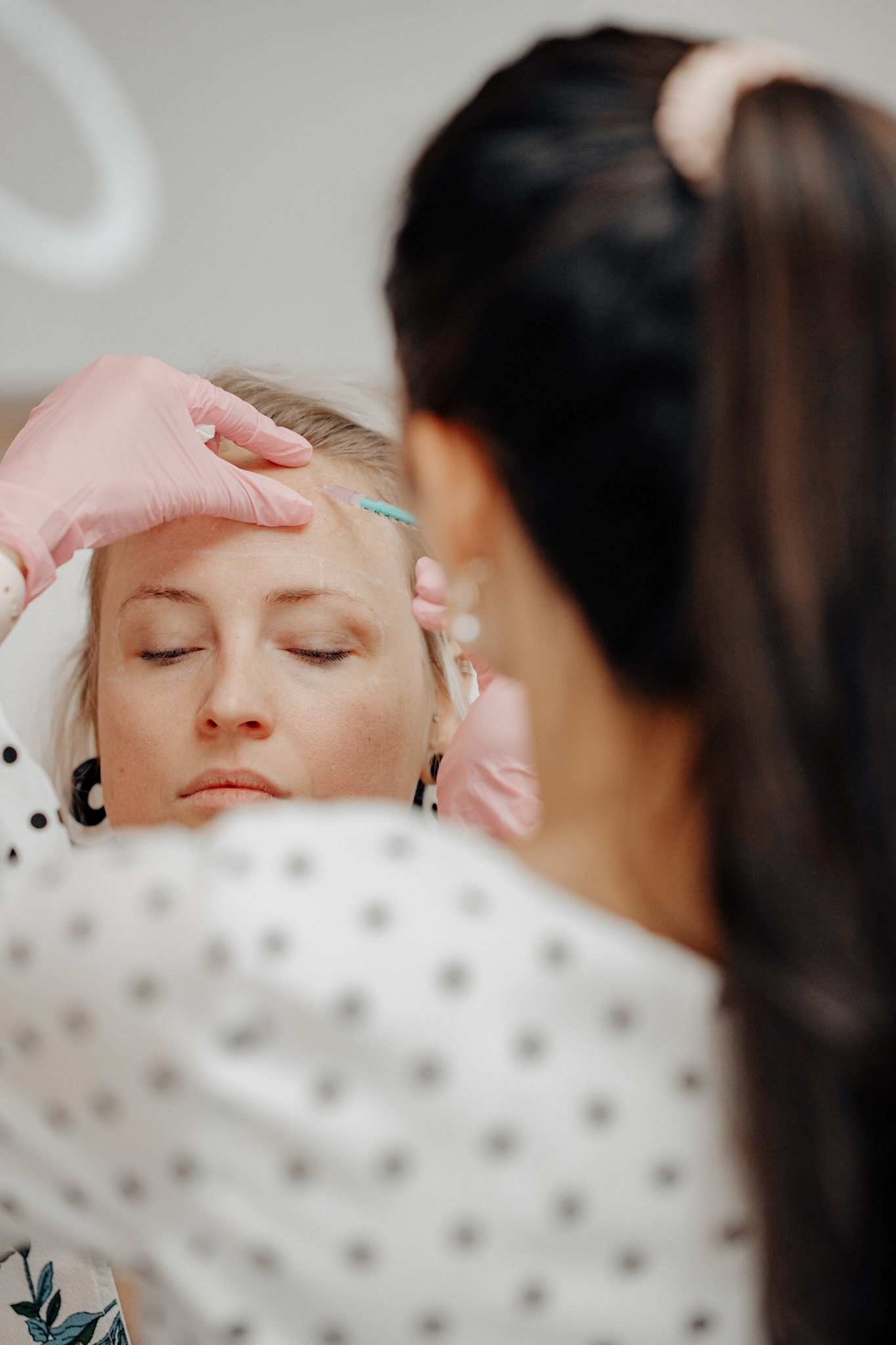
Botox vs Dysport: What’s Actually Different, and Why I Carry Botox and Letybo
Six FDA-approved brands, one job. What the labels say, why units don’t convert, and what I actually use.
Botox vs Dysport is the question I get most from clients who’ve been reading price lists. Short version: they’re both FDA-approved botulinum toxin type A, they do the same job, and the brand matters far less than who’s injecting it. I’m Nurse Bea, an Aesthetic Registered Nurse in Scottsdale. I carry Botox and Letybo, I don’t carry Dysport, Xeomin, Jeuveau or Daxxify, and this post is the honest version of why.
What’s the difference between Botox and Dysport?
Both relax the muscle that folds the skin; the differences are in how they’re made, how the units are counted, and what the FDA label covers. Botox Cosmetic has been FDA-approved since 1989 for frown lines, crow’s feet, forehead lines and neck bands, while Dysport’s cosmetic approval (2009) covers frown lines in adults under 65.
Cleveland Clinic’s cosmetic surgeon adds two things injectors talk about: Dysport tends to kick in more quickly because of its formulation and how it spreads after injection, and Dysport is often described as having a wider spread than Botox, meaning it may extend out farther from the injection point. Wider spread can be useful on a big forehead and a liability next to an eyebrow. Neither is a reason to pick a brand before you’ve picked an injector.
Which is better, Botox or Dysport?
Neither, and anyone who tells you otherwise is selling the one they stock. Cleveland Clinic says it plainly: neither is automatically better for every patient or treatment area.
What does change the result is dose, placement, and whether the injector starts conservatively and brings you back to check. That’s true whichever vial is open on the tray.
How long does Dysport last compared to Botox?
About the same. At matched doses, Botox and Dysport have similar duration of action, too, both lasting three to four months at equally potent dosage, and any difference is not clinically significant.
Clients of mine who’ve had both elsewhere almost never feel a difference once it’s settled. When one “didn’t last,” it was almost always under-dosed, not the wrong brand.
Are Dysport units the same as Botox units?
No. Every label says the same thing: Botox units cannot be compared to nor converted into units of any other botulinum toxin products, and Dysport’s units are not interchangeable with other preparations of botulinum toxin products.
Injectors still use a rough rule of thumb (in general, one unit of Botox equals three units of Dysport), which is exactly why “Dysport is cheaper per unit” misleads: you need roughly three times as many units. Compare the price of the result, not the price of the unit. My Botox page explains how I price by the unit and what new clients pay.
What are the types of Botox?
“Botox” is one brand; there are six FDA-approved botulinum toxin type A brands used for wrinkles in the US. Here’s what each label actually covers.
| Brand (generic name) | FDA-approved since | On-label cosmetic areas | Do I carry it? |
|---|---|---|---|
| Botox Cosmetic (onabotulinumtoxinA) | 1989 | Frown lines, crow’s feet, forehead lines, neck (platysma) bands | Yes |
| Dysport (abobotulinumtoxinA) | 2009 | Frown lines, adults under 65 | No |
| Xeomin (incobotulinumtoxinA) | 2010 | Frown lines, forehead lines, crow’s feet | No |
| Jeuveau (prabotulinumtoxinA-xvfs) | 2019 | Frown lines | No |
| Daxxify (daxibotulinumtoxinA-lanm) | 2022 | Frown lines | No |
| Letybo (letibotulinumtoxinA-wlbg) | 2024 | Frown lines | Yes |
Most injectors, me included, treat other areas off-label with every brand; the table is what the FDA has reviewed, not the limit of what’s done. Masseter treatment, for example, isn’t on any of the six labels.
Why do I carry Botox and Letybo, and not Dysport or Xeomin?
Botox because it has the longest track record of any brand, and Letybo because new clients can try it at an introductory price and because I like what I’ve seen it do. Dysport and Xeomin are fine products; I just don’t have a reason to add a third vial.
Focusing on two brands lets me learn the differences between them far better than if I rotated through five. That’s what tells me which one is likely to work better for a particular skin type or person.
Who gets Letybo and who gets Botox in my clinic?
In my clients, Letybo works really well for younger people and anyone with healthier skin, and it tends to kick in faster. Clients with a lot of sun damage, or older clients whose skin isn’t that healthy, youthful texture anymore, usually do best with Botox.
I’ve also found that doubling up on Letybo gets a similar result and duration in those clients. If someone’s forehead holds nicely on 10 units of Botox and they’d rather have Letybo, I’ll typically plan on 20 units of Letybo. That’s my observation, not a conversion chart: Letybo’s own label says its units cannot be compared to or converted into units of any other botulinum toxin products, so this is dosed person by person at the two-week check.
Did my Botox stop working, or should I switch brands?
Usually it’s your skin, not resistance. In my experience the clients whose Botox “stopped working” have sun damage and loose, thin skin that no longer bounces back when the muscle relaxes; the toxin is doing its job and the skin can’t follow.
Before I switch anyone’s brand, I look at the skincare routine and the sun habits first. Fix those and the same brand usually “works” again. Daily sunscreen and a tretinoin routine do more for a forehead than a new vial.
What matters more than the brand?
The injector. Dose, placement, a conservative first visit, and a follow-up are what separate a natural result from a frozen or uneven one, whichever brand is used.
Here’s how I handle that: every new neurotoxin client gets a complimentary two-week check-in. If an area is under-dosed, I touch it up then. That check-in is the equalizer, because it catches the one problem (too little) that people blame on the brand.
Schedule your free consultation — new clients hold their spot with a $50 deposit, credited to treatment or products, or refunded on request. Call (480) 405-0100 · 7054 E Cochise Road B100, Scottsdale, AZ 85253.
More questions I get about Botox brands
Xeomin is made without the additive proteins the others carry; Cleveland Clinic’s dermatologist sums it up as Xeomin doesn’t have any additives, while Botox does. The same article notes there aren’t any comparative studies between the two showing that Xeomin can have fewer side effects like swelling or headaches, so I treat it as a manufacturing difference, not a reason to switch.
I don’t carry it, so I won’t repeat a marketing number I can’t check. The Daxxify label I read lists frown lines and cervical dystonia and makes no comparison with other brands; if you’ve had it and liked it, tell me, and I’ll dose your Botox or Letybo around what you know worked.
Same type of toxin, different company, newer label. Jeuveau is approved only for frown lines, and like every brand its units don’t convert to Botox units, so a “Jeuveau is cheaper” quote has to be compared by the result, not by the unit.
Written by Beatrice Moorefield, RN, LE, LSO — aesthetic registered nurse, licensed aesthetician, skin health educator, and founder of Skin With Bea Esthetics, Scottsdale.
Disclaimer:
The information provided on this website is for general informational purposes only and is not intended as a substitute for professional medical advice, diagnosis, or treatment. Always seek the advice of a qualified healthcare provider with any questions regarding a medical condition or treatment. The content on this website is not intended to diagnose, treat, cure, or prevent any disease. Use of this information is at your own risk. We are not responsible for any adverse effects or consequences resulting from the use of any information provided.