
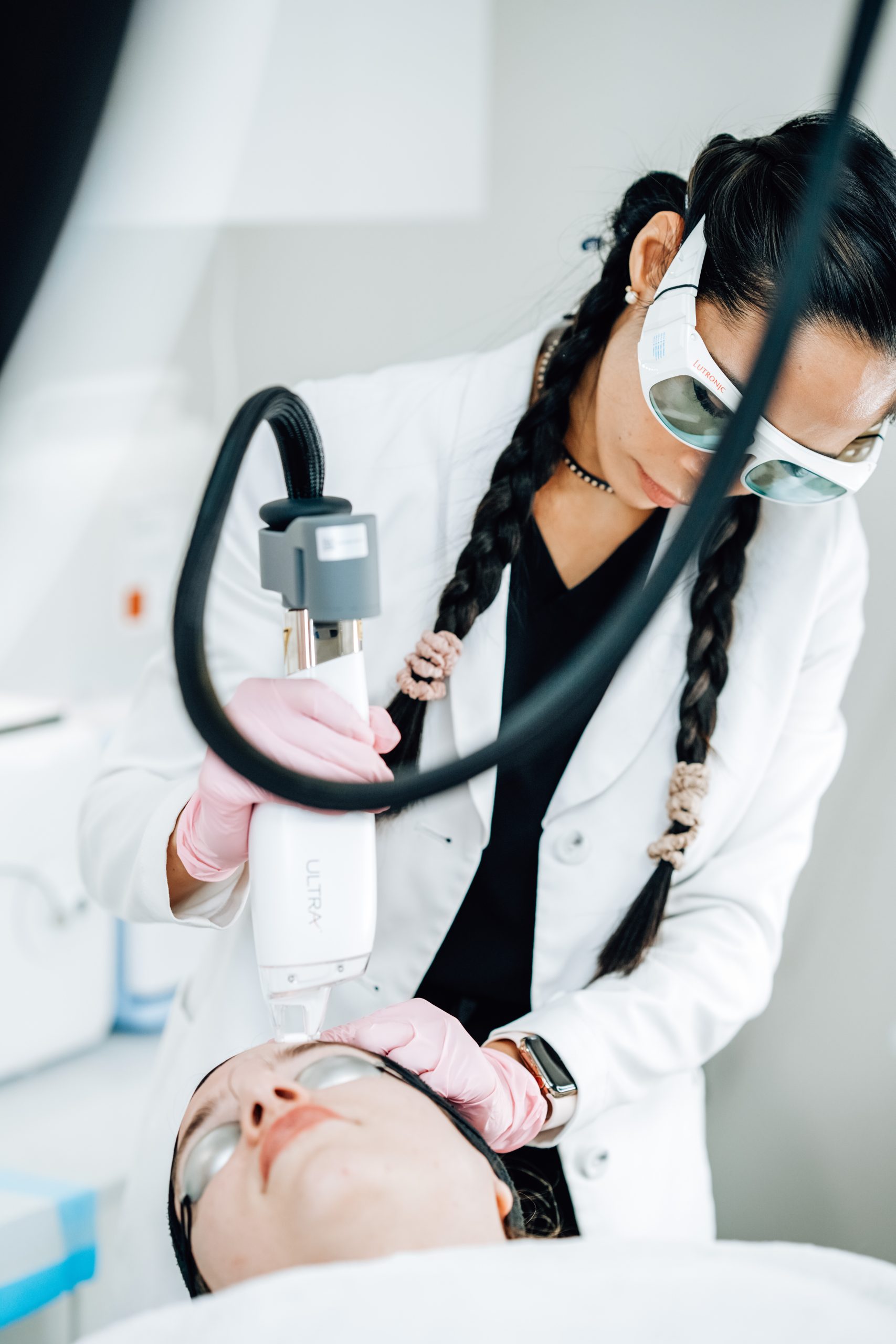
Laser Skin Resurfacing in Scottsdale: Lutronic Ultra vs Moxi vs Clear + Brilliant, From the Nurse Who Chose One
Non-ablative thulium laser resurfacing from $395. Pink for a day, back to work the next, and a free consultation first.
If you’re comparing laser skin resurfacing in Scottsdale, you’ve probably noticed that every clinic has a different laser and every page says theirs is the best. This page tells you what the three lasers people ask me about most actually have in common, what’s different, why I bought the Lutronic Ultra, what the 2.5-hour visit here includes, and who I turn away.
I’m Beatrice Moorefield, an aesthetic registered nurse, licensed aesthetician, Certified Laser Technician and Laser Safety Officer, certified by Lutronic and by Quantum Aesthetics Laser School. Laser treatments here follow my protocol and are performed by me or by a certified aesthetic registered nurse who is also a Certified Laser Technician on my team, under the oversight of our Medical Director, Abbey Jensen, MSN, FNP-C.
Schedule your free consultation — new clients hold their spot with a $50 deposit, credited to treatment or refunded after the visit.











What is laser skin resurfacing, and is a “laser facial” the same thing?
Laser skin resurfacing uses light energy to injure the skin in a controlled way so it rebuilds smoother, more even and firmer; the word covers everything from aggressive ablative lasers to gentle no-downtime ones. A “laser facial” is the gentle end of that range, and ours is the Lutronic Ultra, a non-ablative fractional thulium laser.
The split that matters is ablative versus non-ablative. An ablative laser like a CO2 destroys the outer layer of skin and heats the layer beneath, and new skin usually covers the area in 7 to 10 days, with full recovery taking a month or more. A non-ablative laser leaves the surface intact and treats the layers below it in microscopic columns, which is why Mayo Clinic describes its recovery as shorter and its results as gradual and progressive. The Ultra is a 1927 nm thulium laser indicated for coagulation of soft tissue, actinic keratosis and benign pigmented lesions, which in plain terms means sun damage, age spots and rough, dull skin. It is FDA-cleared, not “FDA-approved”; devices are cleared, drugs are approved.
We run it two ways. The Laser Facial is the resurfacing treatment: thirty minutes of numbing and the stronger settings. UltraGlo is the same laser on a low-density setting with about ten minutes of numbing, a 70 to 80 minute visit, and gentle enough that it is the one laser we use on skin with inflamed acne.
Lutronic Ultra vs Moxi vs Clear + Brilliant: what’s the difference?
All three are non-ablative fractional lasers that treat pigment and texture without removing the skin’s surface, and two of them use the exact same wavelength. The differences that will actually change your result are the settings the operator chooses, what is paired with the laser in the visit, and the price, not the brand name on the handpiece.
| Laser | Wavelength | Ablative? | Typical recovery | Where you’ll find it |
|---|---|---|---|---|
| Lutronic Ultra (LaseMD Ultra) | 1927 nm thulium | No | Pink for a day; sandpaper feel 5–7 days | Here (Laser Facial, UltraGlo) |
| Sciton Moxi | 1927 nm | No | Non-ablative; manufacturer describes it as targeting water within cells | Other Scottsdale medspas |
| Clear + Brilliant | 1440 nm (original handpiece); 1927 nm (Perméa handpiece) | No | Non-ablative; depends on which handpiece the clinic owns | Other Scottsdale medspas |
| CO2 (ablative) laser | — | Yes | New skin in 7–10 days; a month or more to fully recover | Dermatology and plastic-surgery offices |
The facts behind that table: Sciton describes Moxi as a non-ablative 1927 nm wavelength that targets water within cells, the same wavelength as the Ultra. Clear + Brilliant’s 1927 nm Perméa handpiece was added to a system whose original handpiece is 1440 nm, so the result depends on which one your clinic owns. And the 1927 nm wavelength matters because it has roughly ten times the water absorption of 1440 to 1550 nm lasers and penetrates only about 200 microns, which is exactly where sun damage and surface pigment live.
I’ll be honest about how I chose. I didn’t line up spec sheets. I had a treatment with the Lutronic Ultra on my own skin before I bought one, and I loved the result. I also liked that Lutronic is a Korean company, because in my experience Korea leads in aesthetic technology, and that the device is compact. The main reason, though, was my own face in the mirror a few weeks later.
What does the Ultra laser treat, and what doesn’t it?
It is at its best on sun damage, especially age spots, and on the dull, rough texture that comes with years of Arizona sun. It also softens fine lines and, on the right settings, helps clear acne-prone skin; it does nothing for sagging skin, deep static wrinkles or volume loss. The before and after of a 78-year-old client’s age spots and wrinkles after a single Laser Facial is in the portfolio.
Sun damage and age spots are what I reach for the Ultra for first, and the published results back that up: in a study of non-ablative 1927 nm fractional resurfacing, two treatments produced moderate to very significant improvement in about 68% of people’s sun spots at one month, and 82% for overall photodamage. Melasma is different. It can be treated, but only on very gentle settings, because laser can cause rebound hyperpigmentation in melasma if it’s pushed, which is why lower fluences are recommended; if you have melasma, expect a conservative plan and a home routine first. For acne, it’s the UltraGlo setting (the acne transformation in the portfolio used it), and it works alongside the acne program, not instead of it. For skin that has lost firmness or has rolling acne scars, the laser is not the tool; that’s RF microneedling, and for both problems at once the two are paired as the TotalSkin Solution. It also isn’t a vascular laser, so for the visible blood vessels of rosacea I refer out; my rosacea treatment guide covers what helps instead.
Is laser skin resurfacing safe for darker skin tones?
Yes, with the right wavelength and the right settings: because 1927 nm energy is absorbed by water rather than melanin and stays within about 200 microns of the surface, non-ablative fractional lasers are used on Fitzpatrick skin types III through VI. We still treat darker skin more conservatively than lighter skin, because any laser can trigger pigment if the operator is careless.
That caution is the whole point of a consultation before a laser. On darker or melasma-prone skin we lower the density, we prep the skin at home first, and we don’t chase a result in one visit. Gentle enough for all skin tones is a claim a lot of pages make; the way we make it true is by turning the settings down, not by promising the same treatment to everyone.
Does a laser facial hurt, and what’s the downtime day by day?
On my 1-to-10 scale it doesn’t reach a 5 for the Laser Facial, because you’re numbed for thirty minutes first, and UltraGlo is milder still. Most of our clients look slightly pink for a day, occasionally two, and could go back to work the same or the next day.
Here’s what to expect. That evening: pink, warm, like a mild sunburn. The next morning: the pink is mostly gone, and the skin starts to feel like fine sandpaper. That rough feeling is the treated pigment lifting, and it lasts five to seven days; you’ll feel it more than anyone will see it. My clients in their sixties and seventies usually like a day before making plans; my busy thirty-somethings go to work. My protocols are built so you barely have downtime, and this one is no exception. For comparison, an ablative laser takes 7 to 10 days just to grow new skin.
How many sessions do I need, and how long do results last?
You will see a change after one session; how many it takes to clear sun spots completely depends on how your skin reacts and how fast it heals, which is why we decide at the consultation rather than selling a package. For acne scars, and in the acne program, we usually alternate the laser with microneedling, which in my experience gives a better result than three sessions of the same treatment. Unlike Botox, the improvement in fine lines and texture lasts a long time, and it fades only as fast as you let the sun back in.
The research matches what I see: non-ablative results are gradual and progressive rather than instant, and in the 1927 nm study the sun-spot improvement was still there at three months in about half of people after only two treatments. What decides how long yours lasts is the same thing that decides how long your Botox lasts: daily sunscreen and a retinoid keep it, sun and lifestyle take it back. Maintenance here is a conversation at your follow-up, not a subscription.
What happens during the 2.5-hour laser facial appointment?
A Laser Facial here takes about two and a half hours because the laser is one step of six: a cleanse, thirty minutes of numbing, the laser pass, a mild peel if your skin is tolerating things well, a skin booster, a ten-minute hydrating cooling mask and thirty minutes of LED. At most clinics the same price buys fifteen minutes under a laser and a lobby.
In order: I wash your face and apply numbing cream, which sits for thirty minutes. I remove it and do the laser. Depending on how your skin looks and how you’re tolerating it, I may add a mild peel that is formulated to be paired with in-office treatments. Then I infuse a skin booster, most often a retinoid, and follow it with the ten-minute hydrating cooling mask, which is everyone’s favourite part. You finish with thirty minutes of LED. If I’m not sure the products you use at home are safe on freshly treated skin, you go home with an aftercare kit to use until it runs out, and we talk through which of your own products are safe before, after and long term. The booster and the peel are why we bought a laser whose channels open the skin for a few minutes: they’re going in while the door is open.
How much does laser skin resurfacing cost in Scottsdale?
At Skin With Bea the Lutronic Ultra Laser Facial is currently $495 for the full 2.5-hour visit described above, and the gentler UltraGlo setting is currently $395 for a 70 to 80 minute visit, less per session when you buy a series; both include numbing, the peel when your skin allows, the booster, the mask, the LED and the aftercare kit. The consultation is free; new clients hold their spot with a $50 deposit that goes toward treatment or products, or is refunded on request.
Paired with Genius RF microneedling as the TotalSkin Solution it is $1,200 a session, less per session in a package. If you’ve priced resurfacing elsewhere in Scottsdale you’ll have seen ablative CO2 and surgeon-office lasers quoted far higher; they do more in one visit and cost you a week or two of recovery. This is the other end of the trade-off, on purpose.
Is laser resurfacing worth the money, and what’s the downside?
For sun damage, age spots and dull, rough texture that products have stopped improving, yes, and the published numbers above say so. It is not worth it for a single deep wrinkle, for sagging skin, or for anyone who won’t wear sunscreen afterwards, because the sun is what put the spots there and will put them back.
The downside of resurfacing in general is the recovery and the pigment risk when a laser is pushed too hard, which is exactly why I chose a non-ablative thulium over an ablative laser: we don’t burn your skin off for quick results. The downside of ours is that it’s gradual. If you want one dramatic session and can take two weeks off, an ablative laser at a dermatology or plastic-surgery office is the honest recommendation, and I’ll tell you so at the consultation.
What should I avoid before and after a laser facial?
Before: no sunburn, no recent tanning, no photosensitising antibiotics, and no laser during pregnancy. After: sunscreen every day without exception, no retinoids or acids for about a week unless we gave them to you, no heat or heavy sweating for 48 hours, and no picking at the sandpaper phase.
I turn away anyone who arrives with an obvious sunburn, because sunburned skin can’t be treated with a laser, and we don’t treat during pregnancy, because laser and IPL are not indicated for cosmetic procedures in pregnancy due to the lack of safety data. I also ask about medication: the FDA lists antibiotics such as doxycycline, ciprofloxacin, levofloxacin and tetracycline as drugs that make skin more sensitive to light, and I won’t laser skin that is on them. Afterwards, Mayo Clinic’s advice is the same as mine: always use sun protection following laser resurfacing, with SPF 30 or higher every day.
Can an aesthetician do laser treatments? Who performs it here?
What a given licence is allowed to do with a laser varies by state and by device, so the question to ask any clinic is who, specifically, will be holding the handpiece and what they are certified on. Here it is Beatrice Moorefield, RN, LE, LSO, an aesthetic registered nurse and licensed aesthetician who is a Certified Laser Technician and Laser Safety Officer, or a certified aesthetic registered nurse who is also a Certified Laser Technician on her team following the same protocol, with medical oversight from Abbey Jensen, MSN, FNP-C.
I was certified on this device by Lutronic and trained at Quantum Aesthetics Laser School, and every setting we use on your skin comes from that protocol, not from a preset. Nobody here works on commission, so nobody is paid to talk you into a stronger treatment than your skin needs.
Looking for laser skin resurfacing near you in Scottsdale, Paradise Valley or Phoenix?
We’re at 7054 E Cochise Road B100, Scottsdale, AZ 85253, on the Paradise Valley side of Scottsdale, and we see laser clients from Phoenix, Arcadia, North Scottsdale, Fountain Hills, Cave Creek and Tempe. Hours are Monday to Friday 10am to 6pm and weekends 11am to 5pm, by appointment.
Schedule your free consultation or call (480) 405-0100. New clients hold their spot with a $50 deposit; after the visit it goes toward your treatment or products, or is refunded on request. Not ready for a laser yet? Start with a Personalized Facial and the home routine that makes any laser result last.
More questions I get about laser resurfacing
Same Lutronic Ultra laser, two settings. The Laser Facial is the resurfacing treatment: thirty minutes of numbing and the stronger settings, a 2.5-hour visit. UltraGlo is a low-density pass with about ten minutes of numbing, a 70 to 80 minute visit, and it is gentle enough to be the one laser we use on skin with inflamed acne.
That rough, slightly bronzed feel from day two to about day seven is the treated pigment lifting out as the skin turns over. It is the part you notice, not something others can see, and it is why I say do not pick, and keep the sunscreen on.
Yes, but only on very gentle settings and usually after a home routine has calmed the pigment first, because pushing a laser on melasma can cause rebound hyperpigmentation. Expect a conservative plan rather than a quick fix.
Not while you are on a photosensitizing antibiotic such as doxycycline, ciprofloxacin, levofloxacin or tetracycline, and not with a sunburn or during pregnancy. Tell us every medication at the consultation and we will time the treatment around it.
Not necessarily. If I am not sure the products you already use are safe on freshly treated skin, you go home with an aftercare kit to use until it runs out, and we go through which of your own products are safe before, after and long term. Daily sunscreen is the one non-negotiable.
Written by Beatrice Moorefield, RN, LE, LSO — aesthetic registered nurse, licensed aesthetician, skin health educator, and founder of Skin With Bea Esthetics, Scottsdale.
Disclaimer:
The information provided on this website is for general informational purposes only and is not intended as a substitute for professional medical advice, diagnosis, or treatment. Always seek the advice of a qualified healthcare provider with any questions regarding a medical condition or treatment. The content on this website is not intended to diagnose, treat, cure, or prevent any disease. Use of this information is at your own risk. We are not responsible for any adverse effects or consequences resulting from the use of any information provided.