
Postpartum Hair Loss Treatment in Scottsdale: What’s Normal and What Helps
It’s normal, it usually stops on its own, and there’s a plan for the months in between.
If your hair started coming out by the handful a few months after your baby arrived, you’re not alone. Postpartum hair loss is normal and usually stops on its own, so postpartum hair loss treatment in Scottsdale starts with knowing what to expect, then having a plan for the months in between. I’m Nurse Bea, an Aesthetic Registered Nurse and Licensed Aesthetician, and this is what I go over with new moms who come in worried about their hair.
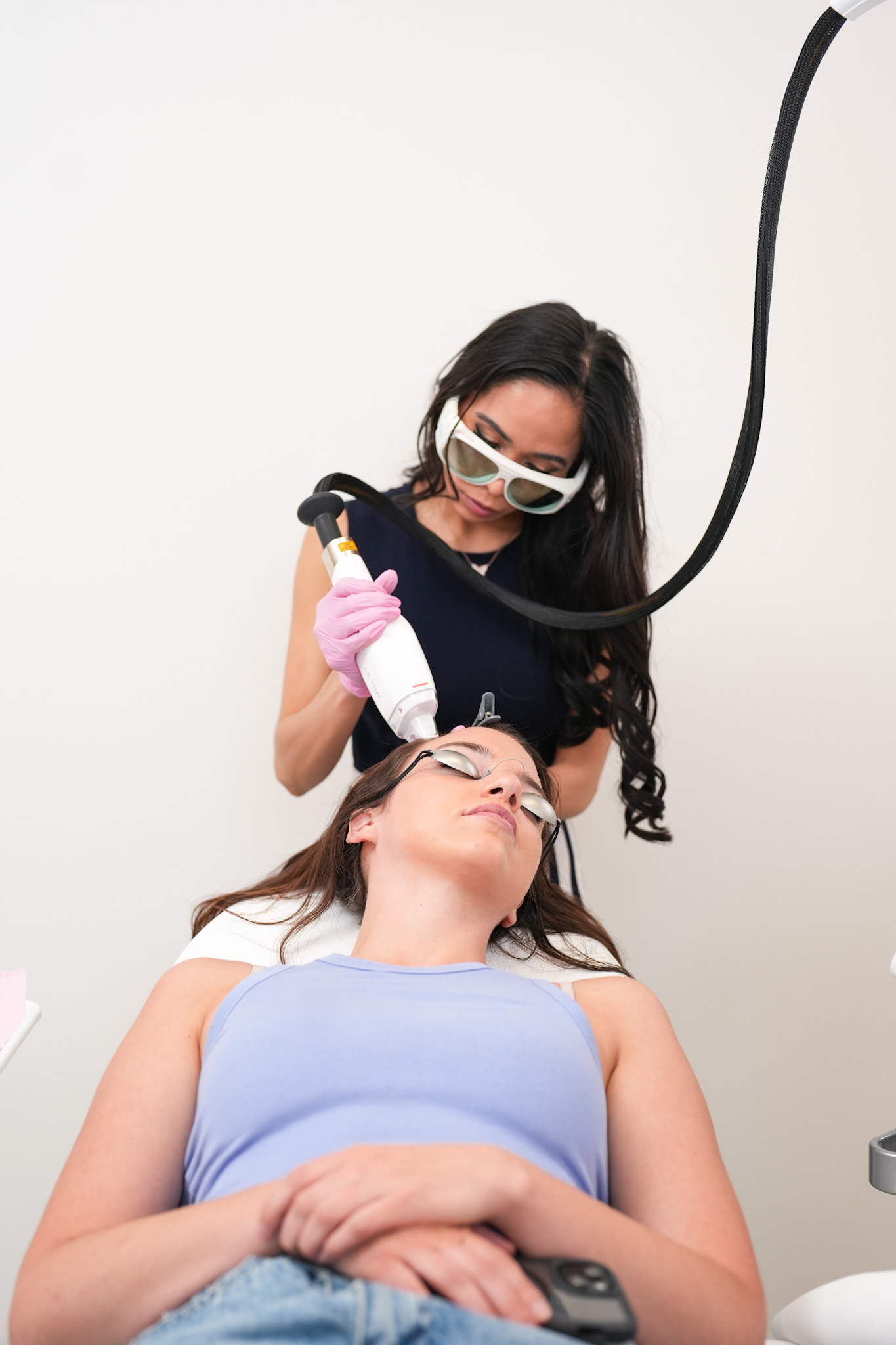
KeraLase in our clinic is done by me or by a certified aesthetic registered nurse who is also a Certified Laser Technician on my team, following my protocol. Our Medical Director, Abbey Jensen, MSN, FNP-C, provides medical oversight.
Schedule your free consultation — new clients hold their spot with a $50 deposit, credited to treatment or products, or refunded on request. Call (480) 405-0100 · 7054 E Cochise Road B100, Scottsdale, AZ 85253.











What is postpartum hair loss?
Postpartum hair loss is heavy shedding that starts a few months after you give birth. After childbirth, estrogen levels drop, and a large number of hairs enter their resting phase at the same time, then fall out.
It isn’t true hair loss. Dermatologists call it telogen effluvium, which means excessive hair shedding, and it’s temporary.
How long does postpartum hair loss last?
Shedding often starts about two months after birth and usually peaks around four months. Most women’s hair is back to its normal fullness by their child’s first birthday, and many get there sooner.
The first thing I tell new moms who come in worried about their hair is that this is normal, and it should stop.
How much postpartum hair loss is normal?
Normal is 50 to 100 hairs a day, and a new mom can shed a lot more than that for a few months after giving birth. Because postpartum shedding thins hair all over, bald patches, shedding that lasts more than six months, or hair that isn’t full again a year after the birth are reasons to see your doctor or a dermatologist.
Round or oval bald patches are how alopecia areata often starts, and shedding that goes on past six months can point to another cause, such as iron deficiency or thyroid disease. After a baby, postpartum thyroiditis affects about 5 to 10% of women. If anything looks off, I’ll send you to your doctor or a dermatologist before we treat anything.
Will my hair grow back after postpartum hair loss?
For most women, yes: having a baby is one of the reasons hair may regrow on its own. A few people may notice their hair stays thinner than it was before pregnancy, and in some, postpartum shedding can “unmask” an underlying pattern hair loss.
If your hair hasn’t come back the way you’d like once the shedding stops, that’s when we talk about KeraLase (more below).
What is the best treatment for postpartum hair loss?
Mostly time, because the shedding usually stops on its own. What helps is being gentle with your hair, making it look fuller while you wait, and supporting the regrowth.
Here’s the home plan I go over with new moms:
- A volumizing shampoo. The AAD recommends a volumizing shampoo and a conditioner formulated for fine hair, used mainly on the ends, and skipping “conditioning shampoos” and heavy “intensive conditioners.”
- Gentle styling. Use lower heat on blow dryers and styling irons, and avoid tight ponytails and braids.
- Five minutes of scalp massage a day. In one small study of nine men, four minutes a day for 24 weeks made the hairs thicker, though not more numerous, so it’s a helper, not a fix.
- A red light cap, such as iRESTORE. Laser caps look promising in the few studies so far, but there’s no solid evidence yet for postpartum shedding itself, so I suggest one to support the regrowth, not to stop the shed.
Do vitamins help postpartum hair loss?
Only if you’re low in something. The AAD says to take biotin, iron or zinc only when a blood test shows you’re deficient, because taking them when your levels are normal can be harmful.
A Cleveland Clinic OB-GYN advises keeping up your prenatal vitamins after birth. Because low iron can show up as hair shedding, ask your doctor to check your iron before you take iron pills, and if you take biotin, stop it at least 2 days before a thyroid blood test, because it can make the results look abnormal.
Which hair loss treatments are safe while breastfeeding?
While you’re nursing, stick to the home plan: a volumizing shampoo, gentle styling and scalp massage, plus a red light cap if your OB-GYN is OK with it. KeraFactor products and KeraLase wait until you’ve finished breastfeeding, and over-the-counter minoxidil isn’t for postpartum shedding.
KeraFactor says its shampoo and conditioner aren’t intended for nursing moms, and we don’t do KeraLase while you’re pregnant, nursing or trying to conceive. The label on women’s minoxidil foam says not to use it when hair loss is linked to childbirth, and that it may be harmful while breastfeeding, and the AAD also says breastfeeding moms should avoid minoxidil. For red light caps, iRESTORE advises checking with your OB-GYN before you start.
| What helps | While breastfeeding | After breastfeeding |
|---|---|---|
| Volumizing shampoo, gentle styling, a fresh cut | Yes | Yes |
| Scalp massage, 5 minutes a day | Yes | Yes |
| Red light cap (iRESTORE or similar) | Ask your OB-GYN first | Yes |
| KeraFactor shampoo, conditioner and solution | Not while nursing | Yes |
| Over-the-counter minoxidil | No | Ask your doctor |
| KeraLase in our clinic | Not while nursing | Once the shedding has settled |
When does KeraLase make sense after a baby?
Once the heavy shedding has settled and you’ve finished breastfeeding, if your hair isn’t coming back as full or as fast as you’d like. KeraLase stimulates follicles that are resting or dormant, but it doesn’t create new ones, so we use it after the shed, when you’d rather not wait for your hair to fill back in on its own.
Each session pairs the LaseMD Ultra laser on your scalp with KeraFactor serum and red light under the iRESTORE Professional in our clinic, and a series is usually six sessions about four weeks apart. How often you need maintenance afterward depends on your hair; some clients only need home care. You can see KeraLase before-and-after photos and the full details on my KeraLase page.
How much does postpartum hair loss treatment cost in Scottsdale?
The consultation is free, and the home plan costs only the products you choose. KeraLase is currently $650 a session, less per session when you buy a series, and nobody here works on commission.
New clients hold their spot with a $50 deposit that goes toward treatment or products, or is refunded on request; it’s kept only for a no-show.
Looking for postpartum hair loss treatment in Scottsdale?
We’re at 7054 E Cochise Road B100, Scottsdale, AZ 85253, on the Paradise Valley side of Scottsdale. We see clients from Phoenix, Arcadia, North Scottsdale, Fountain Hills, Cave Creek and Tempe; hours are Monday to Friday 10am to 6pm and weekends 11am to 5pm, by appointment.
Thinning that started before your pregnancy? See my guide to hair loss treatment in Scottsdale. Stretch marks after pregnancy too? See my stretch mark treatment guide. Shedding on a GLP-1 weight-loss medication? See my GLP-1 hair loss guide.
Schedule your free consultation or call (480) 405-0100. Not sure where to start? See how a consultation works.
More questions I get about postpartum hair loss
No. It has a hormonal cause, so you can’t prevent it; what you can control is how gently you treat your hair while it sheds and grows back.
A new cut can help: some haircuts make hair look fuller, and a good stylist can tell you what will work for your hair.
Most new moms do: most people notice some hair loss after childbirth, and in one Japanese survey, about 9 in 10 women reported it.
Your scalp may look a little pink for a short time afterward, and a few resting hairs can shed in the first day or two. And if you’re still in a heavy shed, we wait until it settles before we start.
No needles and no numbing: clients describe the laser as warm and slightly tingly, and you can go straight back to your day.
Written by Beatrice Moorefield, RN, LE, LSO — aesthetic registered nurse, licensed aesthetician, skin health educator, and founder of Skin With Bea Esthetics, Scottsdale.
Disclaimer:
The information provided on this website is for general informational purposes only and is not intended as a substitute for professional medical advice, diagnosis, or treatment. Always seek the advice of a qualified healthcare provider with any questions regarding a medical condition or treatment. The content on this website is not intended to diagnose, treat, cure, or prevent any disease. Use of this information is at your own risk. We are not responsible for any adverse effects or consequences resulting from the use of any information provided.