
Melasma Treatment in Scottsdale: Why It Keeps Coming Back, and the Plan That Keeps It Faded
A home-first melasma plan, with gentle laser and microneedling when you want faster results, and a free consultation first.
If you’re looking for melasma treatment in Scottsdale, here’s what I want you to know before you spend a dollar: melasma can’t be erased, but it can be managed, often well enough that it stops being the first thing you see in the mirror. I’m Nurse Bea, an Aesthetic Registered Nurse and Licensed Aesthetician, and I treat melasma the way I treat hormonal acne, as something you control for the long term rather than something you finish. This page explains what melasma is, why it comes back, what makes it worse under the Arizona sun, and the plan we use to fade it and keep it faded.
Melasma treatments here are performed by me or by a certified aesthetic registered nurse who is also a Certified Laser Technician on my team, following my protocol, with medical oversight from our Medical Director, Abbey Jensen, MSN, FNP-C.
Schedule your free consultation — new clients hold their spot with a $50 deposit, credited to treatment or products, or refunded on request. Call (480) 405-0100 · 7054 E Cochise Road B100, Scottsdale, AZ 85253.











What is melasma, and how is it different from sun spots and other hyperpigmentation?
Melasma is a hormone-driven pigment condition that causes tan, brown, grayish-brown or bluish-gray patches, usually on the cheeks, forehead, chin and above the upper lip. Sun spots are a different problem, small, flat, tan to dark brown spots caused by years of UV light, and the two need very different treatment even though they can look alike.
Melasma is one kind of hyperpigmentation, the umbrella word for skin that’s darker in patches, and a lot of people don’t know they have it until someone tells them. That matters, because if you don’t know it’s melasma and you book an aggressive laser, IPL or a strong peel, your melasma is going to get worse. To most people a dark patch is a dark patch. To someone who treats skin for a living, melasma and sun spots look different, and there’s no lab test to settle it: melasma is diagnosed mainly by examining the skin, and Wood’s lamp findings are inconsistent, particularly in darker skin. So the first question to ask any clinic is whether they can tell the difference, and what they’d do differently if it’s melasma.
| Melasma | Sun spots (age spots) | Post-inflammatory dark spots | |
|---|---|---|---|
| What drives it | Hormones, made worse by light, heat and irritation | Years of UV exposure speeding up pigment production | Healing after a pimple, an injury or an irritating product |
| What it looks like | Patches of tan, brown or gray-brown | Small, flat, oval tan to dark brown spots | A few shades darker than your skin, sometimes slate blue to gray |
| Where it shows up | Cheeks, forehead, chin, above the upper lip | Backs of hands, face, shoulders, upper back | Wherever the inflammation was |
| What we do first | A long-term plan: tinted SPF, a prescription topical, gentle treatments | Sun protection, then the Laser Facial | Treat what caused it, protect from the sun, give it time |
What causes melasma, and why does it get worse?
Hormones start it and light keeps it going. The American Academy of Dermatology lists sunlight, tanning beds, pregnancy hormones, birth control pills, stress and thyroid disease as triggers, and in about 40 to 50% of women with melasma, pregnancy or the pill is what set it off.
In simple terms, melasma is triggered by hormones and made worse by sun and heat. Light is the part people underestimate, because it isn’t only UV: visible light has been shown to worsen melasma, especially for people with darker skin tones. Heat has the thinnest research behind it, but what there is points the same way. A clinical review noted that night workers exposed to oven heat, like bakers, had a hard time controlling their melasma and reported it worsening after work, and the heat from IPL devices can aggravate it, particularly in darker skin. That’s why summers here are hard on melasma, and why I talk about heat as much as sunscreen.
The last trigger is the one you can change tonight: irritation. If a skin care product burns or stings, it’s irritating your skin, and that may darken dark spots. Melasma and acne share most of their triggers. Both are hormonal, and both flare when you use the wrong products. The two things I see aggravate my melasma and acne clients most are fragrance and long lists of plant extracts, and “natural” skincare is usually full of plant extracts. That isn’t just my preference: fragrances and preservatives are the most common cosmetic allergens.
Can melasma go away?
No treatment makes melasma go away for good. The AAD says it plainly: treatments can fade the discoloration, but they cannot make melasma go away forever, and it can come back, and clinical reviews describe a chronic, relapsing course with recurrence rates high enough that long-term therapy is necessary.
I always compare it to acne, especially hormonal acne. You don’t get rid of hormonal acne once and walk away; you manage it, and whatever cleared it is what keeps it clear. Melasma works the same way. Whatever you do to fade it, you have to maintain. You can’t just stop. Even the label of Tri-Luma, a prescription cream FDA-approved for melasma, says it’s for short-term treatment, not maintenance, and that melasma usually recurs once it’s stopped.
The good news is that managed can look like clear skin. Managed means you know what triggers yours, you have a routine that keeps it faded, and you know what to do when summer pushes it back.
What is the best treatment for melasma?
The best treatment for melasma is a plan, not a single procedure: daily tinted sunscreen, a prescription topical used consistently, a skincare routine built to support it, and gentle in-office treatments when you want faster results. Topicals and sun protection are the foundation, and the conservative clinical view is to keep lasers for selected, hard-to-treat cases rather than lead with them.
That’s why the first thing I do after an in-depth consultation isn’t sell you a treatment. I teach you how to manage your melasma at home. I don’t want to sell you treatments, especially if you don’t know how to manage your melasma at home first. Home care alone is slower than pairing it with treatments in the clinic, but it’s definitely doable.
The prescription is the non-negotiable part. We work out which topical prescription is right for you, and then everything else you use, your cleanser, your moisturizer, your sunscreen, has to support it and add to it, not fight it. Once your routine is working, I explain the in-office program: alternating laser and microneedling, either the gentle pair (UltraGlo and Cosmetic microneedling) or the stronger pair (the Laser Facial and Medical microneedling). Some melasma can only handle the gentle versions; some skin types can handle more. I won’t know which is yours until you come in and I ask a lot of questions about how sensitive your skin is, and how sensitive your melasma is.
Tretinoin, hydroquinone, tranexamic acid or azelaic acid: which topicals work?
All four have evidence behind them, and the right one depends on your skin. I usually start with tretinoin, give it about three months, and then add azelaic acid if you’re also getting breakouts, a tranexamic acid (TXA) serum morning and night, or both.
Tretinoin is the vitamin A prescription most people know from acne. In a placebo-controlled trial, 68% of people using 0.1% tretinoin rated their melasma improved or much improved after 40 weeks, compared with 5% on the placebo cream. That’s effective but slow, which is why the rest of the plan exists.
Hydroquinone is the classic skin lightener, and it’s prescription territory now: the FDA says there are no FDA-approved or otherwise legally marketed over-the-counter skin-lightening products, a change that took effect in September 2020. Long use carries a rare but significant risk of ochronosis, which is greater in skin of color after more than six months of continuous use, so if a prescriber decides it’s right for you, it’s used for a set period, not indefinitely.
Tranexamic acid is the newer option. A clinical review found topical TXA appears to be as effective as topical hydroquinone, and in a placebo-controlled trial of the tablet form, melasma scores fell 49% at three months versus 18% with placebo, though much of that gain faded within three months of stopping. The oral form is a prescriber’s decision, because it’s used off-label for melasma and requires careful screening for clotting risk.
Azelaic acid is the gentler option, and the one I reach for when melasma and breakouts show up together: in a head-to-head study, 20% azelaic acid lowered melasma scores more than 4% hydroquinone. In the clinic we carry the Derma Made Azelaic Acid Cream, a 15% formula, and the Derma Made TXA Serum, 5% tranexamic acid with alpha arbutin and hexylresorcinol. Those two are my favorites for melasma clients.
Nurses don’t prescribe. If you need a prescription, our Medical Director can prescribe it here when it’s appropriate for you, or you can get it through your dermatologist or a telemedicine service. Whatever you’re prescribed, you pause it a few days before and a few days after each in-office appointment, then go straight back to it.
Is laser safe for melasma, and which laser do you use?
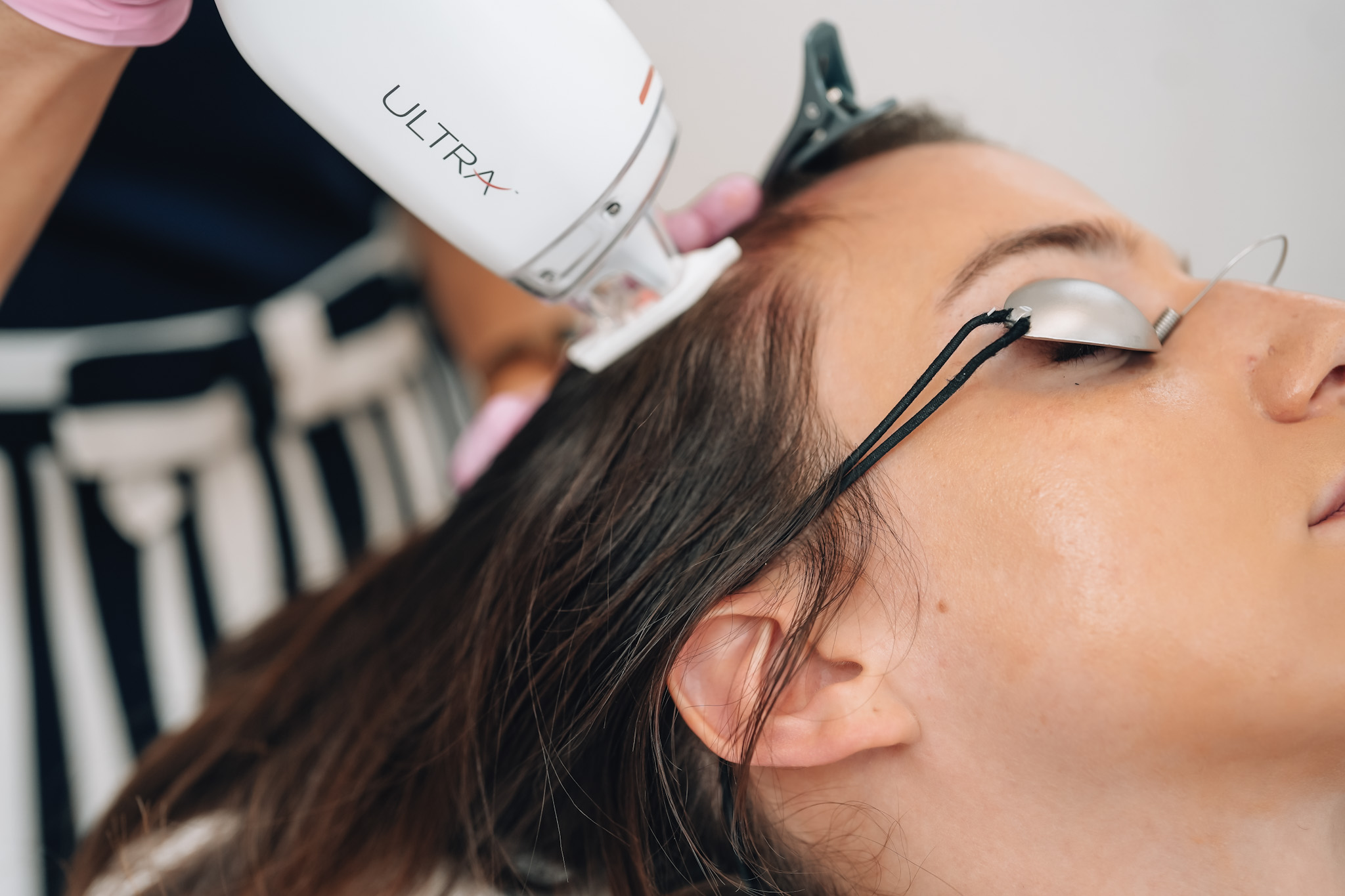
Laser can help melasma, but only on gentle settings and only as part of a plan; the heat from IPL can aggravate melasma, particularly in dark skin, and laser results vary, with some people improving while others relapse or develop new pigment. We use the Lutronic Ultra 1927 nm laser, on its low-density UltraGlo setting for sensitive or reactive melasma, and the stronger Laser Facial only for skin that has shown it can handle it.
Why this laser: the 1927 nm wavelength has roughly ten times the water absorption of 1440 to 1550 nm lasers and penetrates only about 200 microns, and a 2024 treatment review summarized studies in which the 1927 nm thulium fractional laser reduced melasma scores, with sustained improvement and greater tolerance than lower-wavelength fractional lasers. Even so, laser can cause rebound hyperpigmentation in melasma if it’s pushed, which is why lower fluences are recommended. That sentence is the whole reason we start gentle. The device, the visit and the downtime are covered on our laser skin resurfacing page.
Does microneedling help melasma?
Yes, as an add-on. A meta-analysis of 12 studies found that adding topical treatment to microneedling improved melasma more, with a moderate effect at 8 weeks and a large effect at 12 to 16 weeks; a 2024 review still calls the overall evidence low-level, because most studies combine it with topicals, so we use it inside the plan, never instead of it.
For most melasma we start at Cosmetic depth with the Dermapen 4, the super-gentle pass with no numbing, and use Medical depth only for skin that has shown it tolerates more. We alternate it with the laser rather than repeating one treatment three times, the same approach that works best for my acne-scar clients. More about the pen and both depths is on our microneedling page.
Genius RF microneedling is a different tool. It doesn’t treat melasma or other hyperpigmentation, but it is safe for skin that’s prone to them, so having melasma doesn’t rule you out if you need RF microneedling for deeper acne scars, stretch marks or loose skin; we just plan the prep and aftercare around your pigment.
Can a chemical peel or facial help melasma?
A mild peel can help when it’s paired with a gentle treatment, but a strong peel is one of the quickest ways to make melasma darker. A clinical review notes melasma can be triggered or aggravated by cosmetic procedures that inflame the skin, such as peels, and consensus advice stresses cautious technique and diligent sun protection afterwards, especially in skin of color.
The only peels in our melasma visits are the mild ones paired with the laser or the pen, and only when your skin allows. If you’re not ready for in-office treatments yet, a Personalized Facial is a gentle place to start.
What sunscreen is best for melasma?
The best sunscreen for melasma is a tinted, broad-spectrum SPF 30 or higher that contains iron oxides, in a lotion you like enough to reapply. The AAD recommends a tinted sunscreen that contains iron oxide for melasma, and in one trial where everyone also used hydroquinone, people whose sunscreen added an iron-oxide visible-light blocker saw 77% improvement in melasma scores after eight weeks, compared with 61% on UV-only sunscreen.
If you have melasma, you have to learn the habit of reapplying. We find a sunscreen you like enough to reapply, and you reapply the proper amount, following the instructions on the box; the AAD’s rule is every two hours, or sooner if you’ve been sweating. I always tell clients a lotion is best, not a spray, a powder or a stick, because with those it’s hard to know you’ve used enough, and spray sunscreen should never be sprayed around or near your face.
Depending on your skin tone, a tinted sunscreen may do better for you. The ones I recommend most for melasma are EltaMD UV AOX Elements, a tinted mineral SPF 50 that lists iron oxides on its drug label, and the tinted versions of EltaMD UV Clear and EltaMD UV Daily, which list iron oxides too. And wear a hat. Always.
How do I keep melasma from flaring in the Arizona heat?
Keep your face cool, shaded and covered: always wear a hat, don’t let your face stay warm for long, and cool down with cold water when you’re hot. If you use a sauna or steam room, put a cold towel over your head so your face stays cool while the rest of you warms up.
Summer is when melasma pushes back here, because it’s hotter as much as because it’s brighter. Think about where your face spends hot time, the sauna, the steam room, a long afternoon outdoors, and take the heat off it. That’s also the season to be strictest about reapplying, and to keep your melasma routine going even on the days it’s tempting to skip it.
Is melasma treatment safe for darker skin tones?
Yes, with the right settings. Melasma disproportionately affects Fitzpatrick skin types III to V, and the AAD notes people of Latin, Asian, Black and Native American heritage get it more often, so gentle laser and microneedling settings, strict sun protection and close follow-up are what keep treatment from triggering more pigment.
One thing I’ve learned treating darker skin is that even LED light needs watching. I’ve seen some clients with darker skin tones notice their skin getting a little darker with their LED mask. When that happens I tell them to use it less often, and then it works: it helps them, and they don’t get dark spots. That fits the research on light and pigment, where visible light, particularly short-wavelength blue light, has emerged as a significant contributor to melasma. If you use an at-home mask, the kind matters too: the Omnilux Contour we carry uses red and near-infrared light rather than blue, and we still adjust how often you use it to how your skin responds.
Who shouldn’t get melasma treatment? The clients I turn away
Melasma treatment is not for everyone. If you’re always out in the sun without sunscreen, or you like to tan, I won’t treat your melasma, because treatment plus sun makes it worse; if you’re pregnant, the laser is off the table and anything else needs your doctor’s permission first.
I learned the sunscreen part the hard way. I had a client who kept coming in for treatments, and every time I told her to wear sunscreen, she agreed. Her melasma kept getting worse while my other clients were getting better, and I kept trying to work out why. About a year in, once we’d gotten to know each other, she told me she didn’t believe in sun protection and liked to get some sun every day. She’d never said anything. If you’re out in the sun and want to treat your melasma, change that habit first, because otherwise you’re wasting your money and your time.
On pregnancy, most experts recommend stopping topical tretinoin while you’re pregnant, and laser and IPL are not indicated for cosmetic procedures during pregnancy because of the lack of safety data. And sometimes a dark patch is a little questionable. If yours is, I want a dermatologist to check it before I treat it.
How long does melasma treatment take, and what does it cost in Scottsdale?
In my experience most clients see their melasma lighten after the first in-office session, and a full program usually takes three to six months; home care with a prescription alone works too, just more slowly. In-office sessions are currently $298 to $495 each, and our melasma program bundle currently costs 30% less than booking the same sessions one at a time.
It won’t be 100% after one session, but I can’t think of a melasma client who didn’t see some lightening after their first treatment with me. Results vary, and stubborn melasma can need more sessions. The low end of that range is Cosmetic microneedling and the high end is the Laser Facial.
The program is built like our acne and acne-scar programs, in three tiers. The most popular is three laser sessions, UltraGlo or the Laser Facial, alternated with three microneedling sessions at Cosmetic or Medical depth, plus an at-home LED device and a home routine we get right before you start. After that, maintenance is usually just your skincare routine and your topical prescription.
The consultation is free. New clients hold their spot with a $50 deposit that goes toward treatment or products, or is refunded on request; it’s kept only for a no-show. Nobody here works on commission, so nobody is paid to talk you into the stronger treatment.
What happens at a melasma consultation?
We learn your melasma’s story: when it started, what treatments and products you’ve tried, what made it worse and what helped. From there we build your plan, at home only or paired with in-office treatments, and you leave knowing what to use, what to avoid and why.
I’m here to guide you, and I’m here to help you even if you decide not to get treatment from us. I still want to help improve your skin. The list of ingredients to avoid, the sunscreen that suits your skin tone, how to pause and restart your prescription around treatments: all of it gets explained at that first visit, not handed to you on a leaflet.
Looking for melasma treatment near you in Scottsdale, Paradise Valley or Phoenix?
We’re at 7054 E Cochise Road B100, Scottsdale, AZ 85253, on the Paradise Valley side of Scottsdale, and we see melasma clients from Phoenix, Arcadia, North Scottsdale, Fountain Hills, Cave Creek and Tempe. Hours are Monday to Friday 10am to 6pm and weekends 11am to 5pm, by appointment. If your search for melasma treatment in Scottsdale has turned up dermatology pages that give it one paragraph, this is the conversation they don’t have time for.
Schedule your free consultation or call (480) 405-0100. New clients hold their spot with a $50 deposit; after the visit it goes toward your treatment or products, or is refunded on request. Not sure where to start? See how a consultation works, or read how we approach the acne that often comes with hormonal melasma.
More questions I get about melasma
Yes. Melasma is much more common in women, but men get it too, and the plan is the same: daily tinted sunscreen, the right topical prescription, a routine that supports it, and gentle in-office treatment if you want faster results.
For some women it fades after the baby is born or after they stop birth control pills, but many need a plan to clear it. Wait until after delivery for treatment, and check with your doctor before starting any prescription, especially if you’re breastfeeding.
Above the upper lip is one of the most common places for melasma, along with the cheeks, forehead and chin, and it’s often mistaken for a shadow or a faint mustache. That area also takes a lot of irritation from hair removal and lip products, and irritation can darken pigment, so tell us how you remove hair there and what you put on it. Drinking hot drinks may contribute to melasma as well.
It often runs in families. The American Academy of Dermatology notes that your risk is higher if a blood relative has had melasma, and in one study 48% of people with melasma had a relative with it.
No. Melasma is benign and does not turn into skin cancer; it’s a cosmetic condition, not a medical danger. It can still weigh on how you feel about your skin, and that’s a perfectly good reason to treat it.
Yes. Makeup is a perfectly good way to cover melasma while your plan works, and the American Academy of Dermatology suggests exactly that. Choose fragrance-free formulas, and wear your tinted sunscreen underneath, because makeup doesn’t replace it.
Written by Beatrice Moorefield, RN, LE, LSO — aesthetic registered nurse, licensed aesthetician, skin health educator, and founder of Skin With Bea Esthetics, Scottsdale.
Disclaimer:
The information provided on this website is for general informational purposes only and is not intended as a substitute for professional medical advice, diagnosis, or treatment. Always seek the advice of a qualified healthcare provider with any questions regarding a medical condition or treatment. The content on this website is not intended to diagnose, treat, cure, or prevent any disease. Use of this information is at your own risk. We are not responsible for any adverse effects or consequences resulting from the use of any information provided.