
RF Microneedling in Scottsdale: Is Genius RF Worth It? An Honest Answer
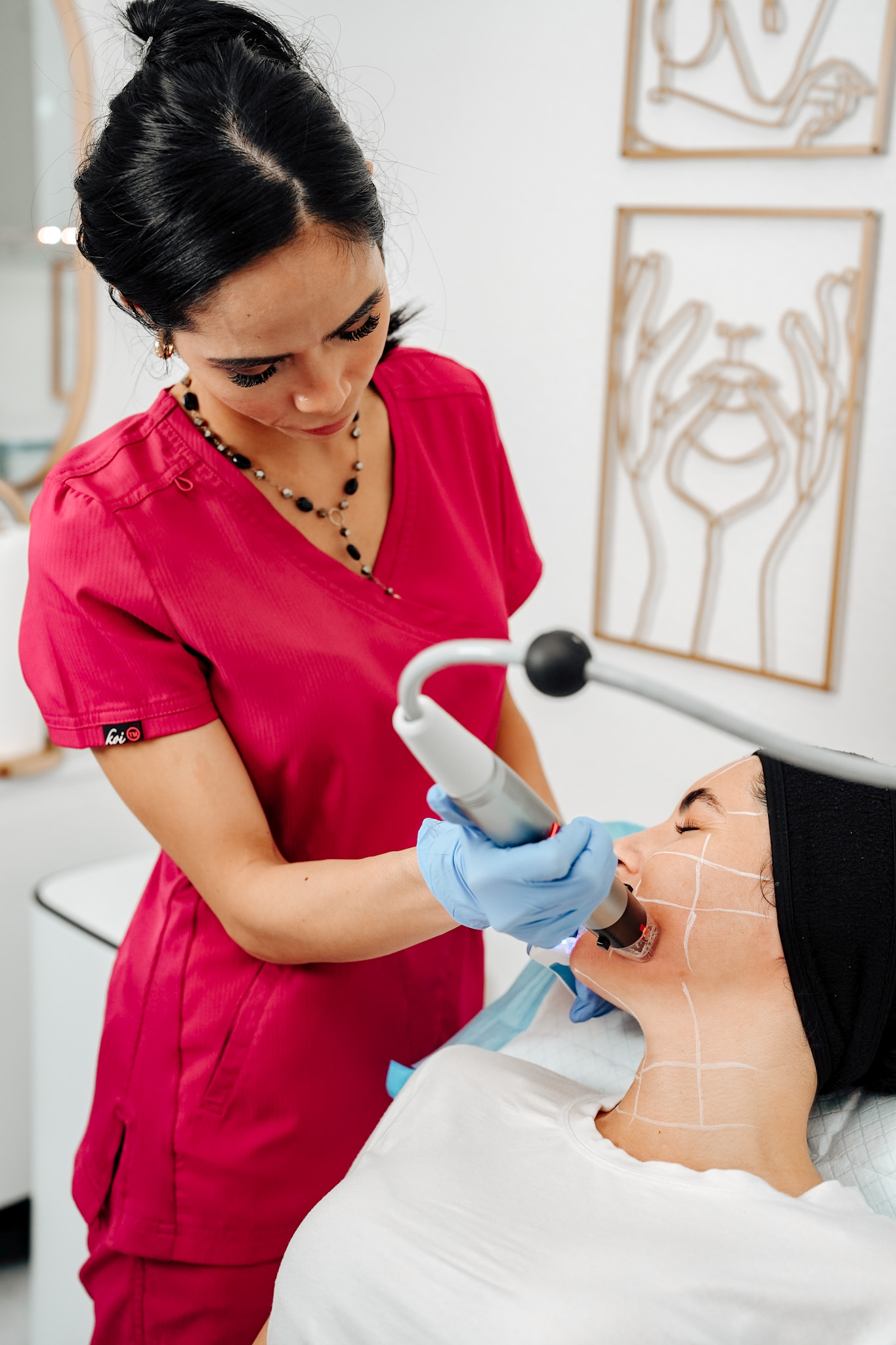
Genius RF microneedling with Nurse Bea. A 2–3 out of 10 on pain, an honest answer on whether you need it, and a free consultation first.
If you’re looking at RF microneedling in Scottsdale, you’ve probably seen two things: a price around $900 to $1,500 a session, and a thread somewhere titled “radio frequency ruined my face.” Both are real. This page is my attempt to tell you, as plainly as I can, when Genius RF microneedling is worth that money and when I’d rather you spend it on something else.
I’m Beatrice Moorefield, an aesthetic registered nurse and licensed aesthetician. I bought a Lutronic Genius for this clinic, I was certified on it by Lutronic and trained at Quantum Aesthetics Laser School, and every treatment here follows my protocol, whether I’m holding the handpiece or one of the certified aesthetic nurses on my team is. I’d rather treat fewer people with it and get the best outcome than sell it to everyone who walks in.
Schedule your free consultation — new clients hold their spot with a $50 deposit, credited to treatment or refunded after the visit.











What is RF microneedling, and what makes Genius RF different?
RF microneedling pushes fine needles into the skin and releases radiofrequency heat from their tips, so collagen is rebuilt from the deeper layers rather than just the surface. Genius is different because it measures your skin’s resistance as the needles go in and adjusts the energy to match, instead of firing the same preset into everyone.
The American Academy of Dermatology describes it simply: it’s a type of microneedling that adds heat to your treatment, and the heat travels down the needles. What separates devices is how that heat is controlled. Genius uses insulated microneedles that penetrate deeply into the dermis to deliver controlled radiofrequency energy, with real-time impedance monitoring that adjusts energy delivery 500 times per second and displays the total energy delivered, so a treatment can be tracked and planned rather than guessed.
Here is why that matters to me. I chose Genius partly because Lutronic is a Korean company, and Korean skincare technology is some of the most advanced there is. But the thing that sold me is the skin impedance monitor. I pick a setting for you based on your skin, your history and your concern. The moment the needles are under your skin, the monitor tells me whether that setting is right for you. If it’s too strong, I see it and I adjust. It is the most personalized device I’ve worked with, and it’s the single biggest reason the horror stories you’ve read don’t have to be your story.
Is RF microneedling worth it?
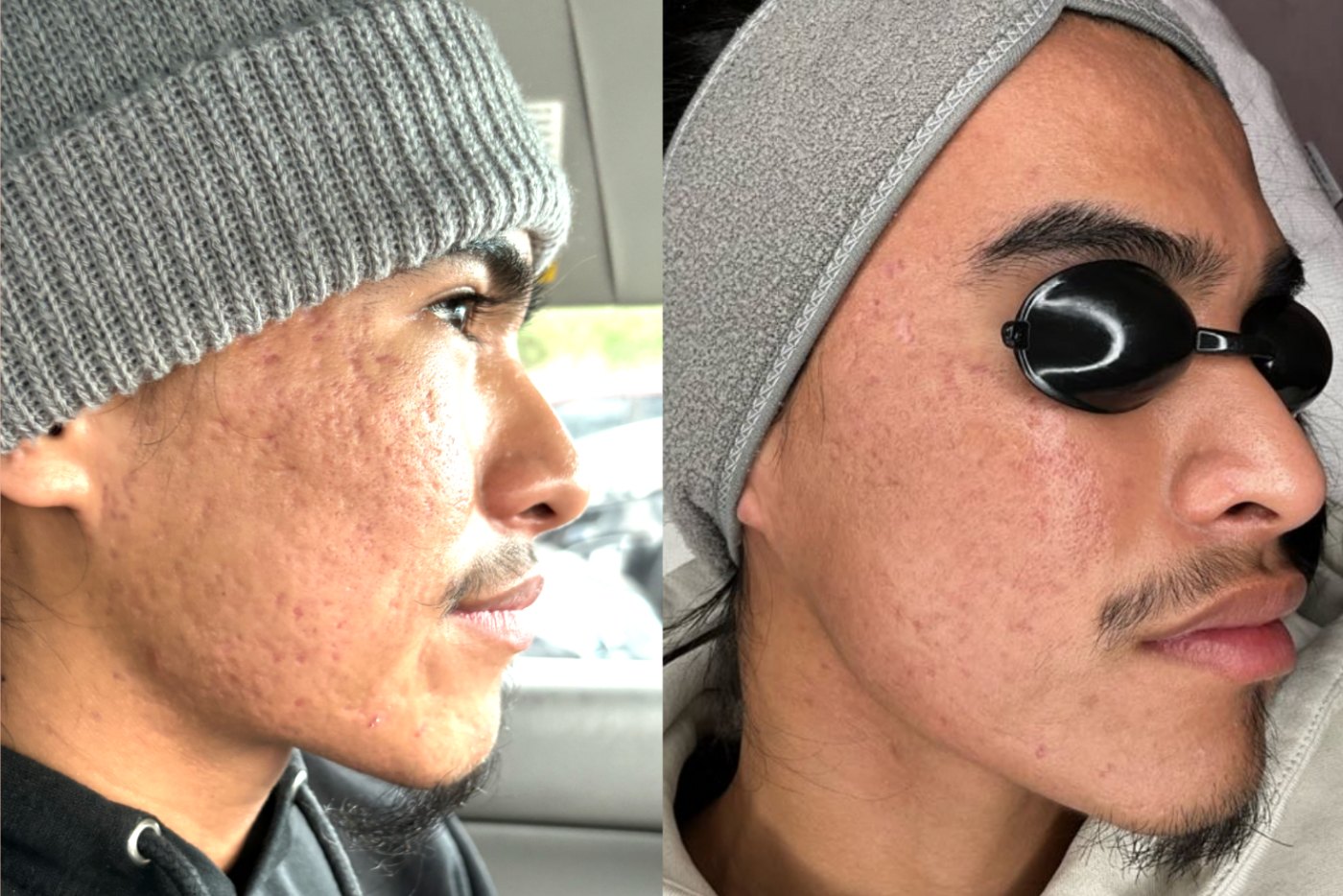
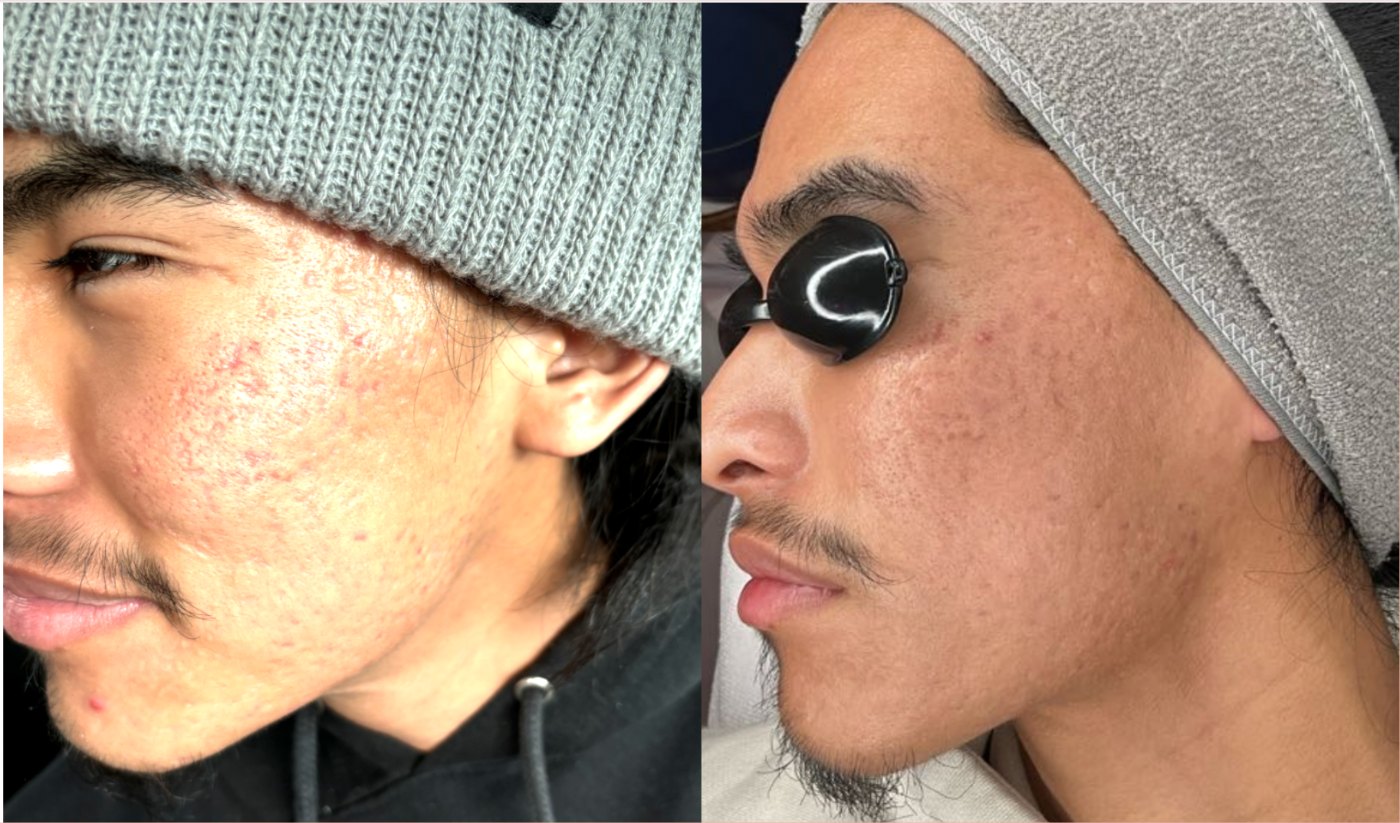
Yes, if you have moderate to severe rolling acne scars, loose stomach skin or stretch marks, because those live at depths that creams and most lasers never reach. No, if your scars are mild, if what bothers you is discoloration, or if you want it for truly sagging skin, and I’ll tell you that at the consultation rather than take your money.
I want to be more specific than most pages are, because “it depends on your goals” is how people end up paying for the wrong treatment. Deep acne scarring, the kind with lots of rolling scars across the cheeks, is where I’ve seen Genius do what nothing else does. Loose skin on the stomach and stretch marks respond well too. But if your acne scars are mild, or the problem is the dark or red marks acne left behind, you don’t need RF microneedling; that’s a job for the right home care and our personalized facial or acne treatment plan. If it’s texture, our non-ablative Ultra laser is enough, at less than half the price. And if your skin is sagging, I’d rather you save the money toward a facelift than spend it on a treatment that will disappoint you. The AAD lists sagging skin among the things microneedling can diminish, and that’s true for mild laxity; it is not a substitute for surgery when skin has really dropped.
How much does RF microneedling cost in Scottsdale?
Genius RF microneedling at Skin With Bea is $900 per session, less if you’re a member or buy a series or package bundle, and that price includes the consultation, the numbing ointment you take home, Pro-Nox during the treatment, a skin booster, a 10-minute cooling hydrating mask, 30 minutes of LED therapy and an aftercare kit. Paired with the Ultra laser in the same appointment, which is our TotalSkin Solution, it’s $1,200 a session, less per session in a package.
I’ll be honest about the pairing, because it’s how I’d spend my own money. I used to offer Genius on its own a lot. What I noticed is that clients were far happier when it was combined with the laser: the RF works in the deeper layers of the skin while the non-ablative Ultra laser, made by the same company, treats the upper layers. One numbing session, one appointment, better and faster results. I don’t waste your time by not telling you that.
On the deposit: if you’re a new client, booking takes a $50 deposit to hold the appointment. After the consultation it goes toward the treatment or toward products, and if we decide together that this isn’t the right treatment for you, you can have it refunded to your account. Returning clients aren’t asked for one.
Why do people say “radio frequency ruined my face”?
Because it can, in the wrong hands. In October 2025 the FDA issued a safety communication on RF microneedling naming burns, scarring, fat loss, disfigurement and nerve damage among the complications reported, and advising patients to seek care from a licensed health care provider with training and experience on the device and to ask which device will be used.
I’ve met a lot of clients whose faces were damaged by another provider, and the pattern is the same every time. The provider followed the manufacturer’s protocol without understanding the why, didn’t screen whether this person was a safe candidate, and sold the treatment anyway, often because they’re paid on commission and RF microneedling is one of the most expensive things on the menu. Needle depth and energy aren’t numbers you copy from a chart. They depend on your skin, your full medical history, the medications you take, your lifestyle and the skincare you use, and on how carefully the person holding the handpiece has looked at all of it. That’s why the first visit here is a consultation, not a treatment, and why the FDA’s own framing is right: this is a medical procedure, not a cosmetic treatment. I’m an aesthetic registered nurse and a Certified Laser Technician, certified on the Genius by Lutronic and trained at Quantum Aesthetics Laser School; anyone else who performs this treatment here is a certified aesthetic registered nurse who is also a Certified Laser Technician working to my protocol, and our Medical Director, Abbey Jensen, MSN, FNP-C, oversees the clinic. I would rather say no to you than have you think of me every time you look in the mirror.
Does RF microneedling hurt, and what’s the downtime?
Here it’s usually a 2 or 3 out of 10, and most people look a little pink that evening and close to normal the next morning. Clients who had it elsewhere, with half an hour of numbing and nothing else, describe it as an 8 or 9 and one of the most painful treatments they’ve had.
The difference is how we set it up. You come in for a consultation first, so we know you’re a good candidate and I can tell you how to prep your skin. You leave with numbing ointment and apply it yourself a full hour before the appointment, not fifteen minutes in a waiting room. During the treatment you have Pro-Nox, patient-controlled nitrous oxide, often called laughing gas. Most people feel a small sting at most. I don’t believe in “no pain, no gain” or “beauty is pain.” You don’t have to suffer for this to work.
Afterward I don’t send you straight out the door. You get a cooling, hydrating mask and then 30 minutes of red and near-infrared LED, which is why the downtime is close to none. The AAD’s general guidance for microneedling is that redness or darker shades on treated skin usually disappear in a few days to a week; with the mask and LED, most of my clients are at the short end of that.
How many sessions do I need, and when will I see results?
It depends on how severe the scarring is and on your medical history, which is why we decide at a consultation rather than quote you a package: sometimes one session is enough, sometimes it takes three or more. If we continue, sessions are about five weeks apart, and we rarely do more than four in a row: most people need four or fewer, though some need more.
Every website in Scottsdale will tell you “a series of three.” I understand why; it’s easier to sell. But everyone reacts differently. We look at the severity of your concern and your history at the consultation, we start, and after the first session we both see how your skin reacted and healed and how much changed, and that tells us whether a second makes sense. If you need several, I’d rather alternate Genius with gentler treatments than stack it. Collagen takes time: the AAD says you may see improvement within a few weeks, and it usually takes several months before you see full results, so the photo you take at five weeks isn’t the finished picture.
Genius RF vs Morpheus8: which is better?
Both are FDA-cleared radiofrequency microneedling devices and both can treat acne scars and laxity; the difference is in how the energy is controlled. Genius measures your skin’s impedance in real time and adjusts the energy as it treats, through insulated needles; that is the feature I bought it for, and it’s the one most relevant to the safety questions above.
I’m not going to run down another device. Morpheus8 is on nearly every page you’ll find for RF microneedling in Scottsdale, and plenty of people have good results with it. What I can tell you is why I chose differently: I wanted a device that tells me, mid-treatment, whether the setting I chose is right for the person in the chair, and one whose energy delivery is confirmed by real-time tissue sensing rather than assumed. I’ve also treated a lot of clients who had Morpheus8 somewhere else first. What they tell me, almost every time, is that it was far more painful than Genius, and that they saw more change with our protocol while barely feeling it. If you’ve had Morpheus8, bring that experience to the consultation; it tells me a lot.
RF microneedling vs regular microneedling vs laser: which do I need?
Regular microneedling for mild scars and sensitive, problematic skin; the Ultra laser for texture, tone and sun damage; Genius RF for deep rolling scars, stretch marks and loose stomach skin; and the two together when scarring sits in both the upper and deeper layers. We offer all four, so the recommendation isn’t driven by what’s on the menu.
| Treatment | Best for | Works at | Pain here | Downtime | From |
|---|---|---|---|---|---|
| Cosmetic microneedling (Dermapen4) | Mild acne scars, sensitive or acne-prone skin, melasma, rosacea | Upper dermis | Low | 1 day of pinkness | $298 |
| Ultra laser (non-ablative thulium) | Texture, dark spots, sun damage, overall brightness | Upper layers | Low | 1–3 days of light flaking | $395 |
| Genius RF microneedling | Moderate to severe rolling acne scars, stretch marks, loose stomach skin | Deep dermis | 2–3 / 10 with numbing + Pro-Nox | Pink that evening, near normal next day | $900 |
| TotalSkin Solution (Ultra + Genius) | Acne scarring with texture and tone on top; the best result per appointment | Upper + deep layers | 2–3 / 10 | As Genius, plus light flaking | $1,200 |
The AAD makes the same point about combining: using both can produce less noticeable acne scars than either radiofrequency or microneedling alone, and a dermatologist treating scars will often use more than one treatment. Which one is right for you depends on what kind of scars you have; ice pick scars, rolling scars and discoloration are three different problems.
Is RF microneedling safe for darker skin tones?
Yes. Because the heat is delivered through insulated needles below the surface rather than on top of it, Genius is one of the few collagen-building treatments I’m comfortable using across all skin tones, including deeper ones. The AAD’s guidance agrees: radiofrequency microneedling is safe to use in people who have darker skin tones.
That’s a real advantage over many lasers, where darker skin carries a higher risk of pigment changes. It is still skin, though, so the consultation matters: if you’re prone to post-inflammatory dark marks or have melasma, the prep and the aftercare are different, and sometimes the right answer is a different plan altogether.
How do I prepare, and what happens after?
Prep is different for every person, which is exactly why the first visit is a consultation and not a treatment. We go through your skin, your medical history and medications, what you’re using at home and what to pause, so your skin is in the best state for the treatment to work.
After the treatment you leave with an aftercare kit and a written plan: what to put on your skin, what to avoid, when makeup is fine. The clients who get the best results treat the in-office session as one part of a plan: a prescription topical from their dermatologist or our Medical Director where one is needed, a home routine built for their skin, and an at-home LED device between visits. The acne-scar before and after on this page came from a client who did all of that, not from the handpiece alone.
Looking for RF microneedling near you in Scottsdale?
We’re at 7054 E Cochise Road B100, Scottsdale, AZ 85253, on the Paradise Valley side of Scottsdale, and we see clients from Phoenix, Arcadia, Tempe, Cave Creek, Fountain Hills and North Scottsdale. Hours are Monday to Friday 10am to 6pm and weekends 11am to 5pm, by appointment.
Every Genius RF treatment here follows the protocol of Beatrice Moorefield, RN, LE, LSO, an aesthetic registered nurse, licensed aesthetician and Certified Laser Technician certified by Lutronic and Quantum Aesthetics Laser School, and is performed by Bea or by a certified aesthetic registered nurse who is also a Certified Laser Technician on her team, with medical oversight from our Medical Director, Abbey Jensen, MSN, FNP-C. No commission, no upsells, and an honest no when it isn’t the right treatment for you. You can see every treatment and price on our services page.
Schedule your free consultation or call (480) 405-0100. New clients hold their spot with a $50 deposit; after the visit it goes toward your treatment or products, or is refunded on request.
More questions I get about RF microneedling
Yes, properly. You take home numbing ointment and apply it for about an hour before the visit, and you breathe Pro-Nox during the treatment, which is why clients here rate it around 2 to 3 out of 10 when the same treatment elsewhere was an 8 or 9. You finish with a cooling mask and 30 minutes of LED.
Yes, those are two of the three things I think it is worth doing for, along with moderate to severe rolling acne scars, because they live at depths creams and most lasers never reach. It is not the answer for truly sagging skin; that is a facelift conversation.
About five weeks, and we rarely do more than four in a row; most people need four or fewer, though some need more. Sometimes one session is enough and sometimes it takes three or more, so we decide after seeing how your skin responds rather than selling a series up front.
Genius RF microneedling and the Lutronic Ultra laser in the same appointment. The RF works in the deeper layers and the laser handles the surface, and clients were noticeably happier with the pairing than with Genius alone, which is why it is how I would spend my own money on scars.
You leave with an aftercare kit and a written plan that tells you what to put on, what to avoid and when makeup is fine for your skin. With the cooling mask and LED most clients have a day or so of pinkness, and makeup goes on once the skin has closed, not the same evening.
Written by Beatrice Moorefield, RN, LE, LSO — aesthetic registered nurse, licensed aesthetician, skin health educator, and founder of Skin With Bea Esthetics, Scottsdale.
Disclaimer:
The information provided on this website is for general informational purposes only and is not intended as a substitute for professional medical advice, diagnosis, or treatment. Always seek the advice of a qualified healthcare provider with any questions regarding a medical condition or treatment. The content on this website is not intended to diagnose, treat, cure, or prevent any disease. Use of this information is at your own risk. We are not responsible for any adverse effects or consequences resulting from the use of any information provided.