
Dark Spot Treatment in Scottsdale: Sun Spots, Melasma or Acne Marks?
Sun spot, melasma or acne mark? How to tell them apart, and the plan that fades each one.
Dark spots aren’t all the same, and the right dark spot treatment in Scottsdale depends on which kind you have. A sun spot, a melasma patch and a mark left by a pimple can look alike in the mirror, but each one fades with a different plan. I’m Nurse Bea, an Aesthetic Registered Nurse and Licensed Aesthetician, and this is how I sort them out with clients.
Treatments here are done by me or by a certified aesthetic registered nurse who is also a Certified Laser Technician on my team, following my protocol.
Schedule your free consultation — new clients hold their spot with a $50 deposit, credited to treatment or products, or refunded on request. Call (480) 405-0100 · 7054 E Cochise Road B100, Scottsdale, AZ 85253.











What causes dark spots on the face?
Dark spots happen when skin makes extra melanin, the pigment that gives skin its color: when skin cells are damaged or unhealthy, they can produce too much melanin. The usual triggers are sun, inflammation such as acne, cuts or burns, and hormone changes like pregnancy.
The trigger decides the plan, which is why the first question I ask isn’t “how dark?” but “what kind?”
Is it a sun spot, melasma or an acne mark?
Look at where the spots sit and how their edges look. Sun spots are small and sharp-edged on sun-exposed skin, melasma is larger blotchy patches, and acne marks sit where pimples were.
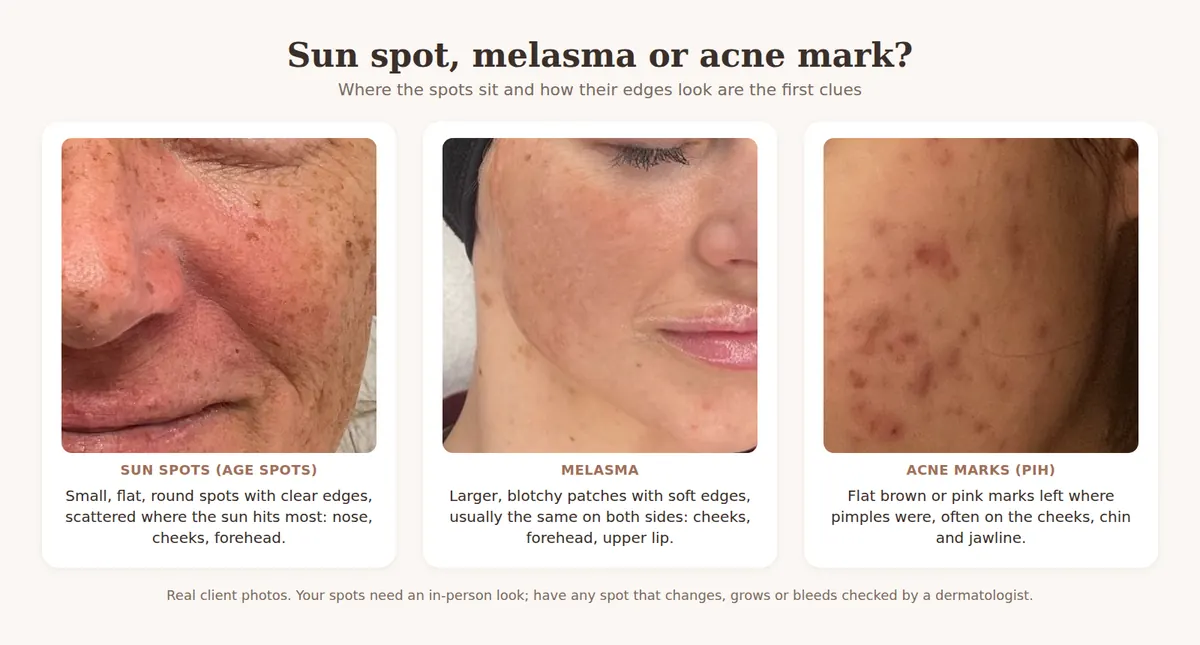
| Sun spots (age spots) | Melasma | Acne marks (PIH) | |
|---|---|---|---|
| What they look like | Flat, usually tan to dark brown | Brown or gray-brown patches, often on both cheeks | Flat brown marks where breakouts were |
| Where | Face, hands, shoulders, arms: wherever the sun hits | Cheeks, forehead, nose, chin, above the upper lip | Wherever you broke out |
| Main trigger | Years of UV exposure | Sun plus hormones; much more common in women | Inflammation from acne; more common in darker skin |
| Where to read more | This page | My melasma treatment guide | Acne scars vs dark marks |
Age spots are also called sunspots, liver spots and solar lentigines. They don’t need medical care, but any spot that is black, growing, bleeding, has an irregular border or an unusual mix of colors needs a dermatologist, not a laser.
How do I get rid of dark spots on my face?
Start with daily sunscreen, add a brightening routine, and bring in treatments when home care stalls. The AAD puts it plainly: effective treatment for dark spots and patches begins with sunscreen.
The most common mistake I see is skipping it. People come in having bought correctors and serums, but they don’t wear sunscreen every day or reapply it, so the spots keep coming back. In Arizona that matters more than most places: Arizonans are diagnosed with melanoma at a rate 28% higher than the rest of the United States.
The acne-mark photo above is me. I faded my own marks in about three months with skincare and sunscreen only: tretinoin, benzoyl peroxide and clindamycin gel 1%, plus sunscreen every morning that I reapplied throughout the day for those three months. No laser. Home care works when you’re consistent; treatments make it faster.
Which sunscreen is best for dark spots?
A broad-spectrum, SPF 30 or higher sunscreen you’ll wear every day, and for melasma or acne marks, a tinted one. The AAD recommends broad-spectrum protection, SPF 30 or higher and water resistance, and its dark-spot guide favors tinted sunscreen with iron oxide, which also protects against visible light.
In the clinic we carry the EltaMD UV Clear, the Derma Made Tinted Sunscreen and a few other tinted sunscreens for different skin types.
Which dark spot products actually work?
The ingredients with the best evidence are retinoids, azelaic acid, niacinamide, vitamin C and tranexamic acid, always on top of sunscreen. A systematic review of acne marks found retinoids, hydroxy acids and broad-spectrum sunscreen were supported by the greatest number of high-quality studies.
- Azelaic acid. A 2023 meta-analysis found azelaic acid may be better than hydroquinone in reducing melasma severity. We carry the Derma Made Azelaic Acid Cream.
- Tranexamic acid (TXA). A 2017 review supports the efficacy and safety of tranexamic acid, alone or as an add-on for melasma. Ours is the Derma Made TXA Serum.
- Niacinamide. In lab and clinical work, niacinamide gave 35–68% inhibition of melanosome transfer, the step that moves pigment into skin cells. Try the Niacinamide Lotion.
- Vitamin C. A 2026 review notes that vitamin C inhibits tyrosinase, reducing melanin synthesis; tyrosinase is the enzyme that starts pigment production. In my experience it’s great for helping prevent sun spots, but not so much for acne marks and melasma.
- Tretinoin. The prescription retinoid. If it’s right for you, our Medical Director can provide it here. While you use it, avoid unnecessary or prolonged sun exposure and wear sunscreen.
Is hydroquinone safe?
It works, but it’s prescription-only now, and I steer clients to azelaic acid, TXA and niacinamide first. The FDA says all over-the-counter skin-lightening products require an FDA-approved new drug application, and the AAD confirms hydroquinone is no longer available without a prescription.
Here in Arizona, I find hydroquinone is more irritating and drying for a lot of people, and it’s more complicated to use: you have to remember when to take a break and when to start again. If those alternatives aren’t enough, hydroquinone goes through a dermatologist, not our clinic. Skip “lightening” creams bought online or abroad; the AAD warns some imported products contain mercury or steroids.
What’s the best in-office treatment for sun spots?
It depends on your skin, which is why the plan starts with a consultation. Depending on your skin type, age, medical history, how severe the spots are and your lifestyle, I might start you on skincare first, go straight to a series of Laser Facials, or alternate Medical microneedling with the Laser Facial.
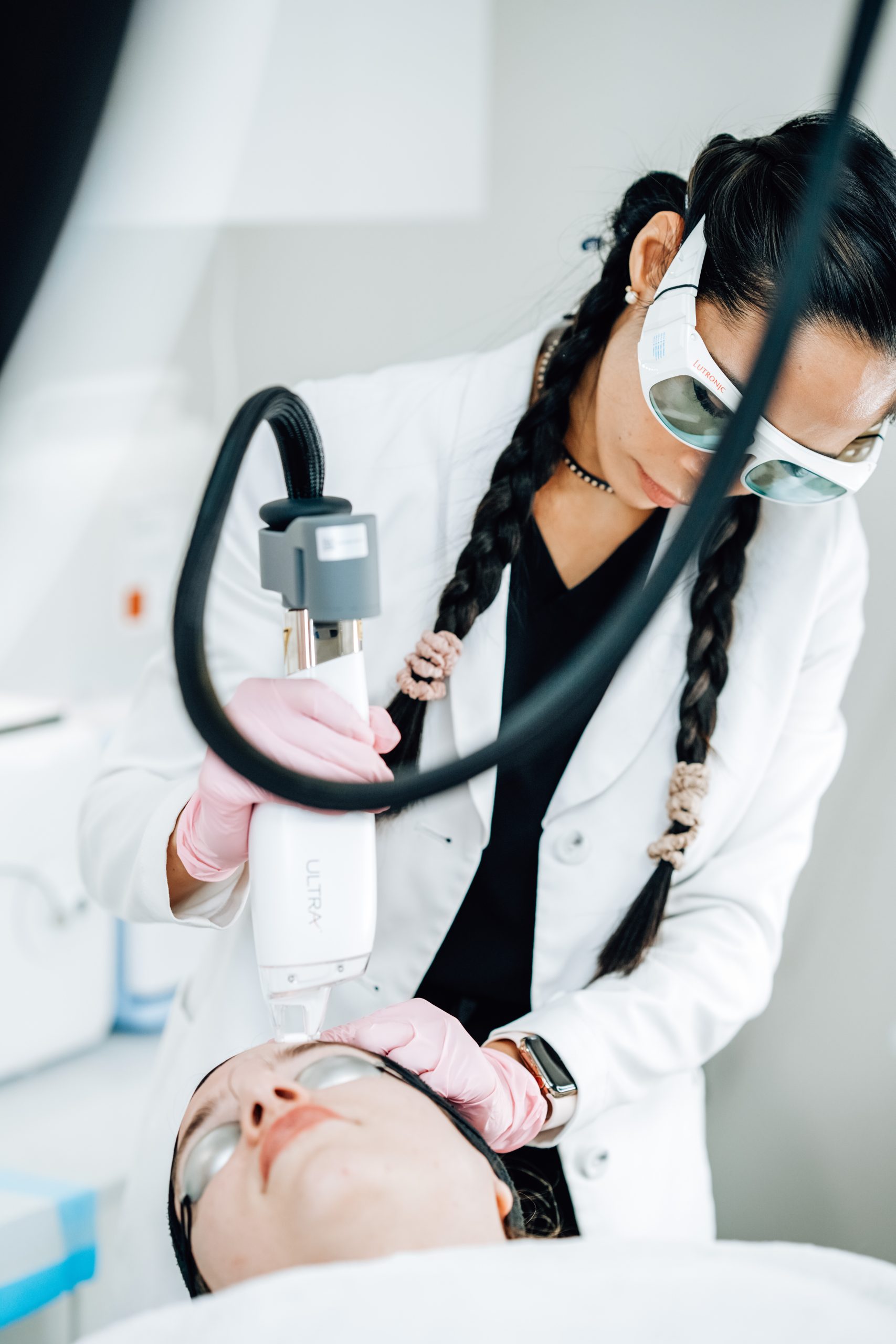
Our laser is the Lutronic Ultra, a 1927 nm thulium laser. Lutronic’s 1927 nm LaseMD laser is FDA-cleared for benign pigmented lesions such as lentigos (age spots), solar lentigos (sunspots) and ephelides (freckles), and in a study of 1927 nm fractional resurfacing for sun-related pigment, treatment produced moderate to marked improvement in overall appearance and pigmentation. Mayo Clinic lists laser, chemical peels and prescription bleaching creams with or without tretinoin among the options.
More on the laser: laser skin resurfacing in Scottsdale and microneedling. Prefer to start gentler? A custom facial with a peel is a good first step.
How long do dark spots take to fade?
Months, not days. The AAD says a spot a few shades darker than your natural skin color will usually fade within 6 to 12 months, and deeper color can take years.
Treatment shortens that, and sun protection keeps the result: for melasma, sun protection can help fade it and prevent it from returning. New sun means new spots, so the sunscreen habit is for life.
Can darker skin tones be treated?
Yes, with more care. Darker skin is more likely to get acne marks in the first place, since post-inflammatory pigment is more common in darker-skinned individuals, and in my experience the wrong treatment can leave new marks.
I see every age, skin type and skin tone here, so the plan is set for your skin: often skincare first to calm and prepare it, gentler laser settings, and slower steps. The AAD’s guide to fading dark spots in darker skin tones is a good read before your visit.
How much does dark spot treatment cost in Scottsdale?
The consultation is free, and many plans start with skincare alone. The Laser Facial is currently $495 a session, less per session when you buy a series, and nobody here works on commission.
New clients hold their spot with a $50 deposit that goes toward treatment or products, or is refunded on request; it’s kept only for a no-show.
Looking for dark spot treatment in Scottsdale?
We’re at 7054 E Cochise Road B100, Scottsdale, AZ 85253, on the Paradise Valley side of Scottsdale. We see clients from Phoenix, Arcadia, North Scottsdale, Fountain Hills, Cave Creek and Tempe; hours are Monday to Friday 10am to 6pm and weekends 11am to 5pm, by appointment.
Schedule your free consultation or call (480) 405-0100. Not sure where to start? See how a consultation works.
More questions I get about dark spots
Usually a combination: daily sunscreen and a proven home routine, plus in-office treatment matched to the type of spot. My own acne marks took about three months with skincare alone; no single product does it overnight.
Yes, if the trigger comes back. Sun makes new spots, and melasma can return, which is why sun protection helps prevent melasma from returning.
They’re different spots, but they’re treated the same way: sunscreen first, and the same 1927 nm laser is FDA-cleared for age spots, sunspots and freckles.
Written by Beatrice Moorefield, RN, LE, LSO — aesthetic registered nurse, licensed aesthetician, skin health educator, and founder of Skin With Bea Esthetics, Scottsdale.
Disclaimer:
The information provided on this website is for general informational purposes only and is not intended as a substitute for professional medical advice, diagnosis, or treatment. Always seek the advice of a qualified healthcare provider with any questions regarding a medical condition or treatment. The content on this website is not intended to diagnose, treat, cure, or prevent any disease. Use of this information is at your own risk. We are not responsible for any adverse effects or consequences resulting from the use of any information provided.