
Does Red Light Therapy Work for Skin? What I See After 30 Minutes Under the LED
Modest, slow and real: what red and blue LED do for skin, from a clinic that ends every treatment under one.
Does red light therapy work? Yes, modestly and slowly, and only if you keep doing it: the research supports less redness, finer lines and faster healing, not a new face. I’m Nurse Bea, an Aesthetic Registered Nurse and Licensed Aesthetician in Scottsdale. Every microneedling and laser client here finishes with 30 minutes under a medical LED panel, and I send most of them home with a mask, so this is the honest version of what it does and doesn’t do.
Does red light therapy work?
It works, within limits. In a randomized controlled trial of 136 volunteers treated twice a week for 30 sessions, the treated subjects experienced significantly improved skin complexion and skin feeling, profilometrically assessed skin roughness, and ultrasonographically measured collagen density, and the dermatologist reviewing it for Harvard Health says plainly, it’s slow and steady. It’s not going to be anyone’s quick fix.
The AAD is careful too: some studies indicate that in general red-light LED devices can produce subtle to noticeable results on the face, and more research is needed. We still do not fully understand the effects of red light on the skin. That matches what I see: a reliable, gentle effect that adds to a good plan, and nothing that replaces one.
What is red light therapy, and how does it work?
It’s low-level red or near-infrared light aimed at the skin, with no heat and no UV. Harvard Health’s definition: known medically as photobiomodulation and previously called low-level laser light therapy, it involves using devices that emit red or near-infrared light aimed at the skin.
The working theory is energy. The light is believed to stimulate mitochondria, tiny “powerhouses” in cells, to reduce inflammation and boost the production of collagen; in the lab, red light activates cytochrome c oxidase, which increases mitochondrial production of ATP. More ATP means cells that repair faster, which is why I use it after treatments rather than instead of them.
What does red light do for the face?
Finer lines, smoother texture, less redness and quicker healing, over months. Harvard Health lists what the research suggests it can help: reduce fine lines and wrinkles, smooth skin texture, diminish redness and accelerate wound healing.
The size of the effect is the useful part. In a three-month study of a red LED mask used twice a week, a significant decrease in the depth of the crow’s feet wrinkle of 15.6% was observed after 28 days of mask use, 34.7% after 56 days and 38.3% after 84 days, and these results last for up to 1 month after stopping the use of the mask. Two caveats: it was 20 people with no control group, and the mask maker helped run it. Read it as “real but modest, and it fades when you stop.”
Red light or blue light for acne?
Both, together. In a randomized trial of 107 people with mild to moderate acne using a light daily for 15 minutes, a mean improvement of 76% (95% confidence interval 66-87) in inflammatory lesions was achieved by the combined blue-red light phototherapy, better than blue light alone or benzoyl peroxide, probably by combining antibacterial and anti-inflammatory action.
That’s why the mask in my acne program is the blue-and-red Omnilux Clear, not a red-only one. Light helps the inflamed pimples; it does not clear blackheads, whiteheads or cysts, so it sits alongside the routine on the acne page, not in place of it.
Why is there 30 minutes of LED after every microneedling and laser visit?
Because the skin has just been worked hard, and I want it to leave calmer than it arrived. In my clients, LED means less redness the same day and a faster, smoother week of healing than the depth of the treatment would predict. I’ll be honest that client by client it’s hard to separate the LED from everything else in the visit; I include it because the evidence points the right way and the downside is zero.
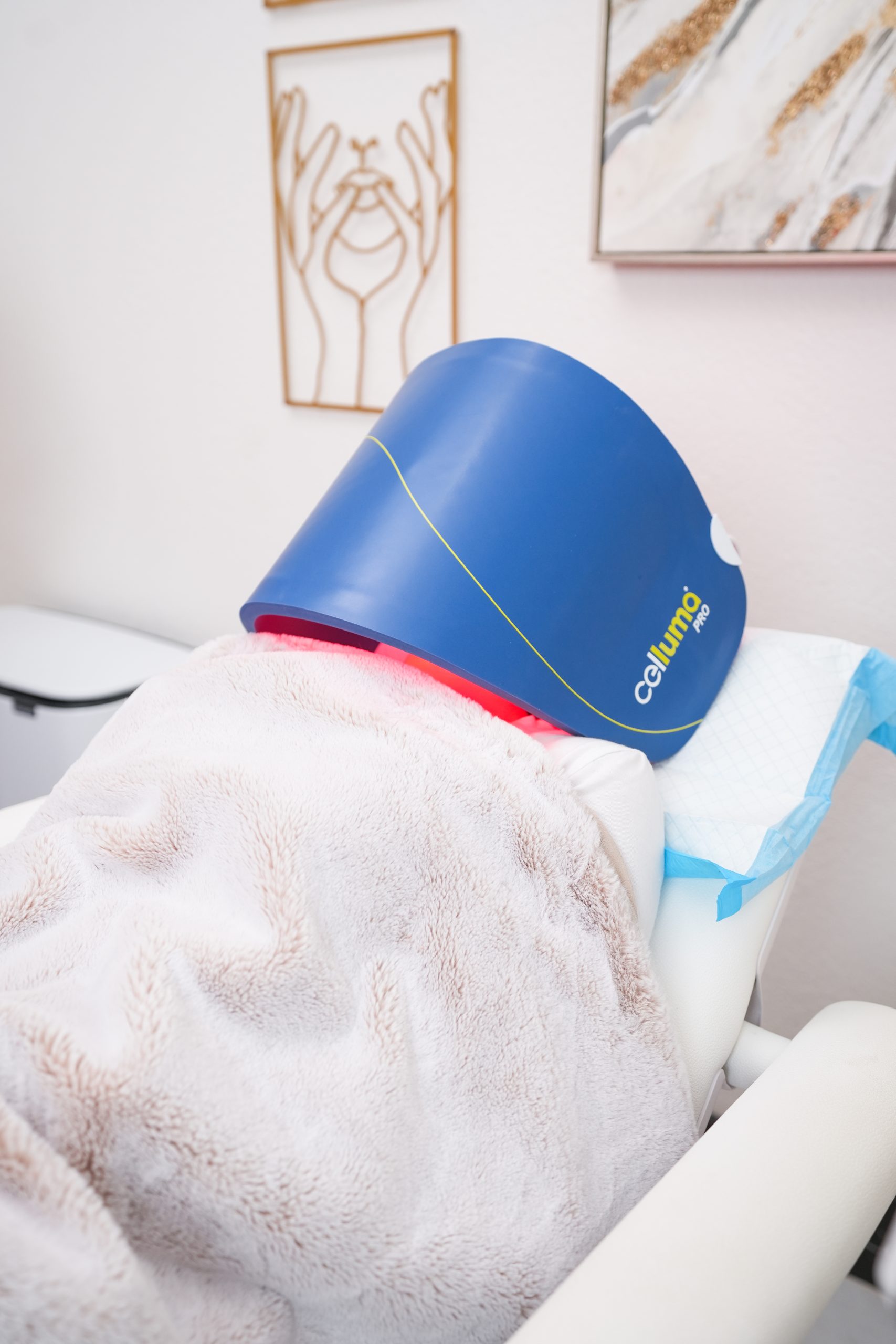
There’s an Arizona reason too. Microneedling and laser leave skin temporarily more sensitive to the sun, and it is always sunny here, so 30 minutes in a dark room under the panel before you step outside is better for the result than walking straight into it. I also like the boost to cell energy right after a treatment that is asking the skin to build new collagen. The panel is a Celluma Pro, a medical LED, and the LED step is part of microneedling, the Laser Facial and the facial, done by me or by a certified aesthetic registered nurse who is also a Certified Laser Technician on my team, following my protocol.
Is an LED mask worth it, and how often should you use it?
Worth it if you’ll use it most nights for months; not worth it if it will live in a drawer. Home devices are weaker than clinic panels, the red light that dermatologists offer is more powerful than that found in devices sold for at-home use, and Harvard’s dermatologist says for the devices to be effective, they must be used multiple times a week for four to six months.
The box says 3 to 5 times a week for 10 minutes; in my experience nightly gives better results, and I haven’t seen side effects from daily use. The one group I slow down is darker skin tones and melasma: research shows that people who have darker skin tones are more sensitive to visible light, such as red light, and if someone notices new dark spots, using the mask less often normally fixes it. These are the three I keep in the clinic:
| Mask | Light | Who it’s for |
|---|---|---|
| Omnilux Contour Face | Red + near-infrared | Fine lines, redness, healing between treatments; the mask in my scar and melasma programs |
| Omnilux Clear | Blue + red | Acne-prone skin; the mask in my acne program |
| Omnilux Mini Blemish Eraser | Blue + red, spot size | A single breakout you want to calm fast |
Is red light therapy safe?
For most people it’s one of the safest things in skincare. The AAD: the most common side effects are mild. Some people develop temporary mild pain or irritated skin from red light therapy, and unlike ultraviolet (UV) light, which can cause skin cancer, research hasn’t found that red light can cause any type of cancer.
In my clinic the only people I don’t put under the LED are those with epilepsy, anyone prone to seizures, and anyone with severe eye sensitivity. I don’t usually use goggles: eyes stay closed, and if the light is comfortable after the first minute, we carry on. At home, follow your mask’s own eye guidance.
Are red light beds and gym panels the same thing?
They’re the same kind of light used for a different job. Full-body beds and panels are built for muscles, joints and general wellness, and the dose that reaches your face is whatever happens to land there. A face mask or a clinic panel is positioned a few inches from the skin for a set time, which is the kind of dosing the skin studies above used. If your goal is your face, use something made for your face.
Can I rent the clinic’s LED panel?
Yes. The Celluma Pro rental is currently $150 for a week or $395 for a month, for anyone who wants clinic-strength LED at home for a few weeks rather than a mask for good. And if you’re in for a facial with a bruise or a sore spot somewhere else, ask: when the second panel is free, I’ll put it on while you’re on the table, no charge.
Where should you start?
Not with the light. The tretinoin-and-sunscreen routine in how to use tretinoin is the most important thing you can do for your skin, and if you haven’t started it, start there. Once that’s a habit, adding an LED mask is a luxury step, and a good one.
If you get regular cosmetic treatments, here or anywhere, that’s where a mask earns its keep: use it for a few days leading up to your treatment and for a few days after, when the skin is doing its repair work. And if you’re planning microneedling or laser here, the LED is already in your visit.
Schedule your free consultation or call (480) 405-0100. Not sure where to start? See how a consultation works.
More questions I get about red light therapy
Weeks for redness, months for lines. In the mask study, crow’s feet were 15.6% shallower at 28 days and kept improving to 84 days; the AAD’s caution is that it takes time to see the results and not everyone sees them.
Some. The AAD says the results from some, but not all, studies show that with repeated treatments, it’s possible for red light to regrow some hair over time, but it won’t regrow a full head of hair. A red light cap is part of the home plan on my hair loss page.
Devices like these are FDA-cleared, not approved, and the AAD is clear on the difference: the FDA clears devices. It doesn’t approve or certify them. Clearance means the device is considered safe for its stated use, not that it works for everything on the box; while FDA clearance and the research results are encouraging, it’s difficult to know how effective at-home devices are.
Written by Beatrice Moorefield, RN, LE, LSO — aesthetic registered nurse, licensed aesthetician, skin health educator, and founder of Skin With Bea Esthetics, Scottsdale.
Disclaimer:
The information provided on this website is for general informational purposes only and is not intended as a substitute for professional medical advice, diagnosis, or treatment. Always seek the advice of a qualified healthcare provider with any questions regarding a medical condition or treatment. The content on this website is not intended to diagnose, treat, cure, or prevent any disease. Use of this information is at your own risk. We are not responsible for any adverse effects or consequences resulting from the use of any information provided.