
Can Sun Damage Be Reversed? What Helps, and What Doesn’t, in Arizona
The honest answer from a Scottsdale nurse: what improves, what doesn’t, and what to do first in the Arizona sun.
Can sun damage be reversed? Partly. The damage to your skin cells’ DNA can’t be undone, but the rough texture, uneven tone, crepey skin and early lines that come with it can improve a lot. I’m Nurse Bea, an Aesthetic Registered Nurse and Licensed Aesthetician in Scottsdale, and after years of looking at Arizona skin, this is my honest answer.
Treatments here are done by me or by a certified aesthetic registered nurse who is also a Certified Laser Technician on my team, following my protocol.











What can and can’t be reversed?
Cleveland Clinic puts it plainly: once UV radiation changes your skin cells’ DNA, the DNA damage can’t be reversed. The AAD says the same, and adds that treatment can reduce some signs of sun damage that are making you look older.
So the question isn’t “can it be reversed” but “which parts can improve”. Here’s how I sort it:
| Sign of sun damage | Can it improve? |
|---|---|
| Rough, leathery texture | Yes, with a retinoid and resurfacing |
| Uneven tone and blotchiness | Yes; dark spots have their own page |
| Crepey neck and chest | Yes, slowly |
| Fine lines | Yes; deep lines less so, see my wrinkle page |
| Scaly or rough spots that don’t heal | A dermatologist first, not a med spa |
What does sun damage look like?
More than spots. Cleveland Clinic lists lines and wrinkles, uneven skin color or uneven skin texture, loss of elasticity, thinning skin, spider veins on the nose and cheeks, and rough scaly spots.
In my chair, the Arizona version looks like this: rough, leathery texture on the cheeks and forehead; crepey skin on the neck and chest; blotchy, uneven tone; and one side of the face worse than the other, usually the driving side. The tell I notice most: you have more wrinkles than your friends who are the same age.
What is photoaging, and why is it worse in Arizona?
Photoaging is skin aging caused by the sun, on top of the aging you’d get anyway. Cleveland Clinic notes that crepey skin typically can be traced to sun damage, and here we get sun almost every day of the year.
Driving adds to it. In a study of 29 cars, windshields blocked about 96% of UVA, but UVA blockage in the driver’s side window was much lower, with an average of 71 percent, which is one reason the left side of the face often looks older than the right.
What should I do first: skincare or treatments?
Skin first, then treatments. In my practice, clients who spend a few months on a prescription retinoid and daily sunscreen before their first laser get more from each session and need fewer of them.
The evidence backs the retinoid: a 2025 meta-analysis of randomized trials found topical tretinoin is an effective treatment for fine and coarse facial wrinkles resulting from photodamage, and Cleveland Clinic notes retinoids provide their best benefit when treating early signs of photoaging. If tretinoin is right for you, our Medical Director can provide it here; tazarotene, the stronger option, comes through a dermatologist.
What helps sun damaged skin at home?
A prescription retinoid most nights, sunscreen every morning, and a moisturizer to keep the barrier calm. The AAD notes a retinoid helps keep pores from clogging, evens out skin tone and reduces fine lines.
Sunscreen does more than prevent: the AAD says sun protection can also help prevent, slow down, and even reverse signs of sun damage, and in a 4.5-year trial, the daily sunscreen group showed no detectable increase in skin aging. I also tell clients to eat plenty of fruit and vegetables for the antioxidants, manage stress, get enough sleep, and, if they want extra cover, consider a Polypodium leucotomos (fern extract) supplement: a systematic review found multiple studies have shown the beneficial photoprotective effects of the Fernblock PLE formulation. I take one every day myself (Heliocare is the brand I use). It’s an addition to sunscreen, not a replacement.
How do you use sunscreen in Arizona?
Enough of it, and again during the day. The AAD’s rule is SPF 30 or higher, broad-spectrum and water resistant, and to reapply sunscreen every two hours, and immediately after swimming or sweating. For the face, I tell clients at least a quarter teaspoon, which is more than most people use.
Then the Arizona extras: a wide-brimmed hat and UV sunglasses, and avoid the peak UV hours, usually between 10:00 am and 4:00 pm. Use a sweat-resistant sunscreen when you hike, put it on before you drive, and remember your left arm and the left side of your face in the car.
Which treatments help sun damaged skin?
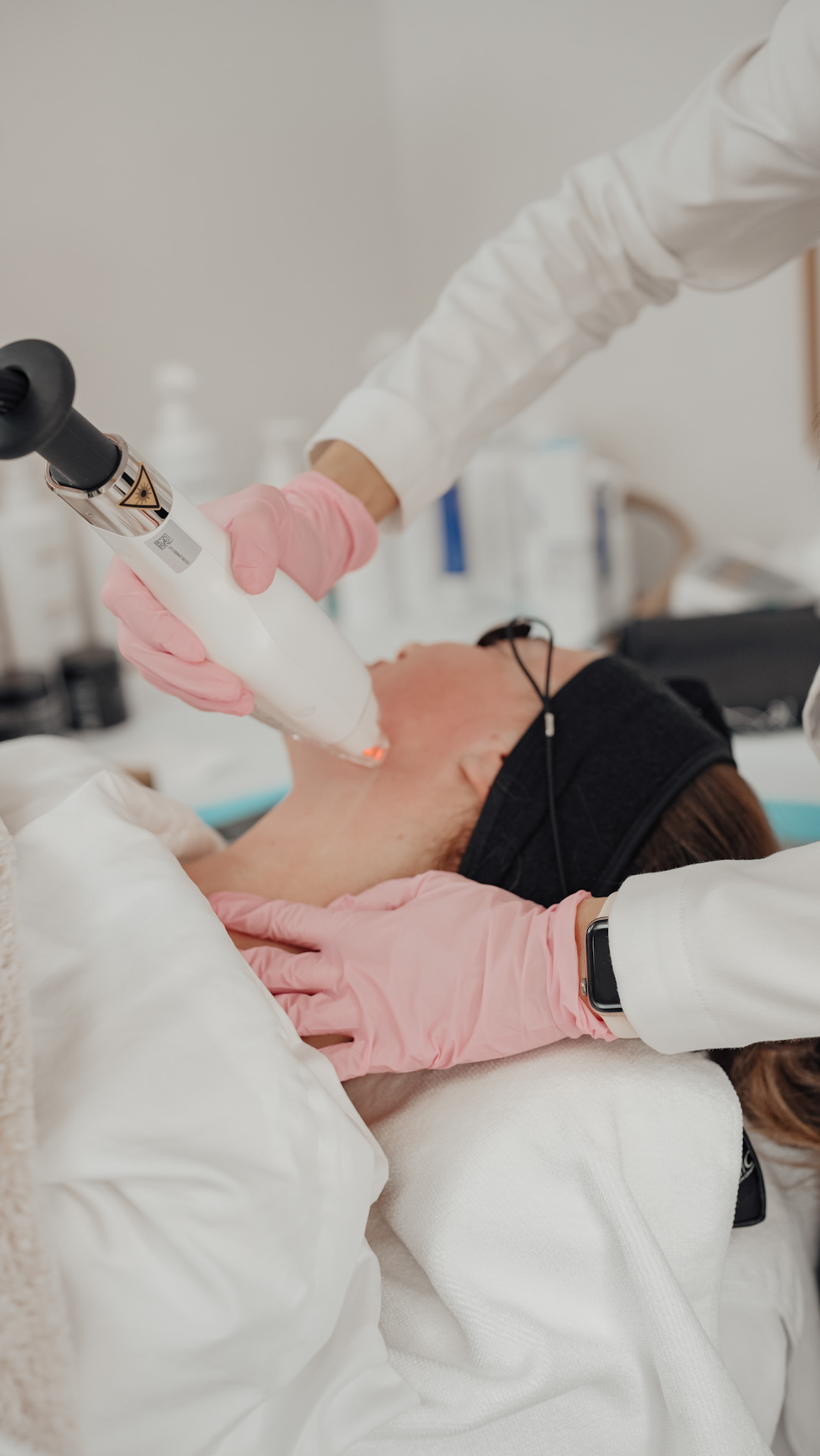
Once the skin is prepped, resurfacing. Cleveland Clinic explains that lasers remove the damaged top layer of skin and increase collagen production, which makes your skin’s surface smoother; here that’s the Laser Facial with the Lutronic Ultra, and a 1927 nm laser like ours produced moderate to marked improvement in overall appearance and pigmentation in a study of facial sun damage.
For texture, microneedling works by stimulating your body to make collagen; for leathery skin with deeper lines, the TotalSkin Solution combines RF microneedling and the laser in one visit. A custom facial with a light glycolic, Jessner or retinol peel is the gentle option: peels remove the outermost layer of your skin so new skin comes to the surface.
Can you treat the neck, chest, arms and hands?
Yes. The neck is included in every facial treatment here except RF microneedling, where it’s an add-on, and the chest is an add-on to any of them.
Arms and hands are treated by area and quoted at your consultation. The same home routine applies: retinoid, sunscreen, and sleeves or gloves when you’re driving or hiking.
When is sun damage a dermatologist’s job?
When a spot is new, changing, bleeding, scaly or won’t heal. The AAD describes dry, scaly patches called actinic keratoses that build with years of sun, and dermatologists are the skin cancer experts.
Anyone with years of Arizona sun should have a yearly skin check. Cleveland Clinic’s advice is simple: see a dermatologist if you’re concerned about the quality of your skin. I’ll tell you if something I see needs a dermatologist before any cosmetic treatment.
Ready to find out what your skin can get back?
The consultation is free and covers your home routine first. We’re at 7054 E Cochise Road B100, Scottsdale, AZ 85253, on the Paradise Valley side of Scottsdale, and see clients from Phoenix, Arcadia, North Scottsdale, Fountain Hills, Cave Creek and Tempe.
Schedule your free consultation or call (480) 405-0100. New clients hold their spot with a $50 deposit, credited to treatment or products, or refunded on request. See how a consultation works.
More questions I get about sun damage
Months, not days. A retinoid shows its changes over a few months, and laser or microneedling results build as collagen does, with the best result 6 to 12 months after a series.
It’s part of every facial and laser visit here for calming and recovery, not a sun damage treatment on its own. The retinoid, sunscreen and resurfacing do the work.
No. Cleveland Clinic notes retinoids provide their best benefit when treating early signs of photoaging, so starting sunscreen and a retinoid now is the cheapest treatment you’ll ever do.
Written by Beatrice Moorefield, RN, LE, LSO — aesthetic registered nurse, licensed aesthetician, skin health educator, and founder of Skin With Bea Esthetics, Scottsdale.
Disclaimer:
The information provided on this website is for general informational purposes only and is not intended as a substitute for professional medical advice, diagnosis, or treatment. Always seek the advice of a qualified healthcare provider with any questions regarding a medical condition or treatment. The content on this website is not intended to diagnose, treat, cure, or prevent any disease. Use of this information is at your own risk. We are not responsible for any adverse effects or consequences resulting from the use of any information provided.