
Hair Loss Treatment in Scottsdale: Why Your Hair Is Thinning, and What Actually Helps
KeraLase laser hair restoration with Nurse Bea. No needles, no surgery, no downtime.
If you’re looking for hair loss treatment in Scottsdale, you’ve probably already noticed that most of what comes up is either a hair transplant clinic or a PRP injection. Neither is wrong. But for most people in the early stages of thinning, neither is the first step either.
We’re Skin With Bea Esthetics, a nurse-led medspa on E Cochise Road, and we treat thinning hair with KeraLase: a laser-assisted scalp treatment with no needles, no surgery and no downtime. Before we talk about that, though, let’s talk about why your hair is thinning in the first place, because that’s the part that decides whether any treatment will hold.











Why is my hair thinning?
Most thinning comes from one of three things: hair follicles gradually shrinking under the influence of hormones (pattern hair loss), a temporary shock that pushes a lot of hairs into their resting phase at once (shedding), or something happening on the scalp itself. Which one you have changes the plan completely, and you usually can’t tell from the mirror alone.
Some numbers to ground this. It’s normal to shed between 50 and 100 hairs a day; when it’s noticeably more than that, the medical term is telogen effluvium. Pattern loss is different. Female pattern hair loss is the most common cause of hair loss in women, and while it most often starts in midlife, we see it in clients in their 30s all the time. New moms are their own case: shedding often starts about two months after giving birth and peaks around four months, then usually settles on its own.
The reason this matters: a treatment that helps pattern loss won’t fix a thyroid problem, an iron deficiency, or a scalp that’s inflamed. That’s why every plan here starts with a consultation, not a treatment.
Can hair loss be reversed?
Thinning from follicles that are still alive but resting can improve; a follicle that has fully scarred over cannot be brought back. That’s why the earlier you treat thinning, the more you have to work with.
Hair grows in a cycle. Each follicle spends several years in the growth phase, a few weeks transitioning, and up to nearly a year resting, and at any given time about 10 to 15% of your hairs are in that resting phase. Thinning usually means more follicles are sitting in rest, or producing finer hairs, not that they’ve disappeared. Treatments like KeraLase work on exactly those follicles: the manufacturer is clear that it stimulates existing follicles that are resting or dormant but does not create new ones. We’d rather you hear that from us now than be disappointed later.
What should I stop doing when my hair is thinning?
Stop waiting, and stop treating your scalp roughly. Tight ponytails and braids, daily heat, harsh clarifying shampoos and aggressive brushing all put stress on follicles that are already struggling, and every month you wait is a month of follicles drifting further into rest.
The other thing to stop is guessing. Trying a new shampoo for six weeks, then a supplement for six weeks, then giving up, is the pattern we see most often, and it’s the one that costs people the most time. Find out what’s actually going on first.
What is KeraLase, and how does it work?
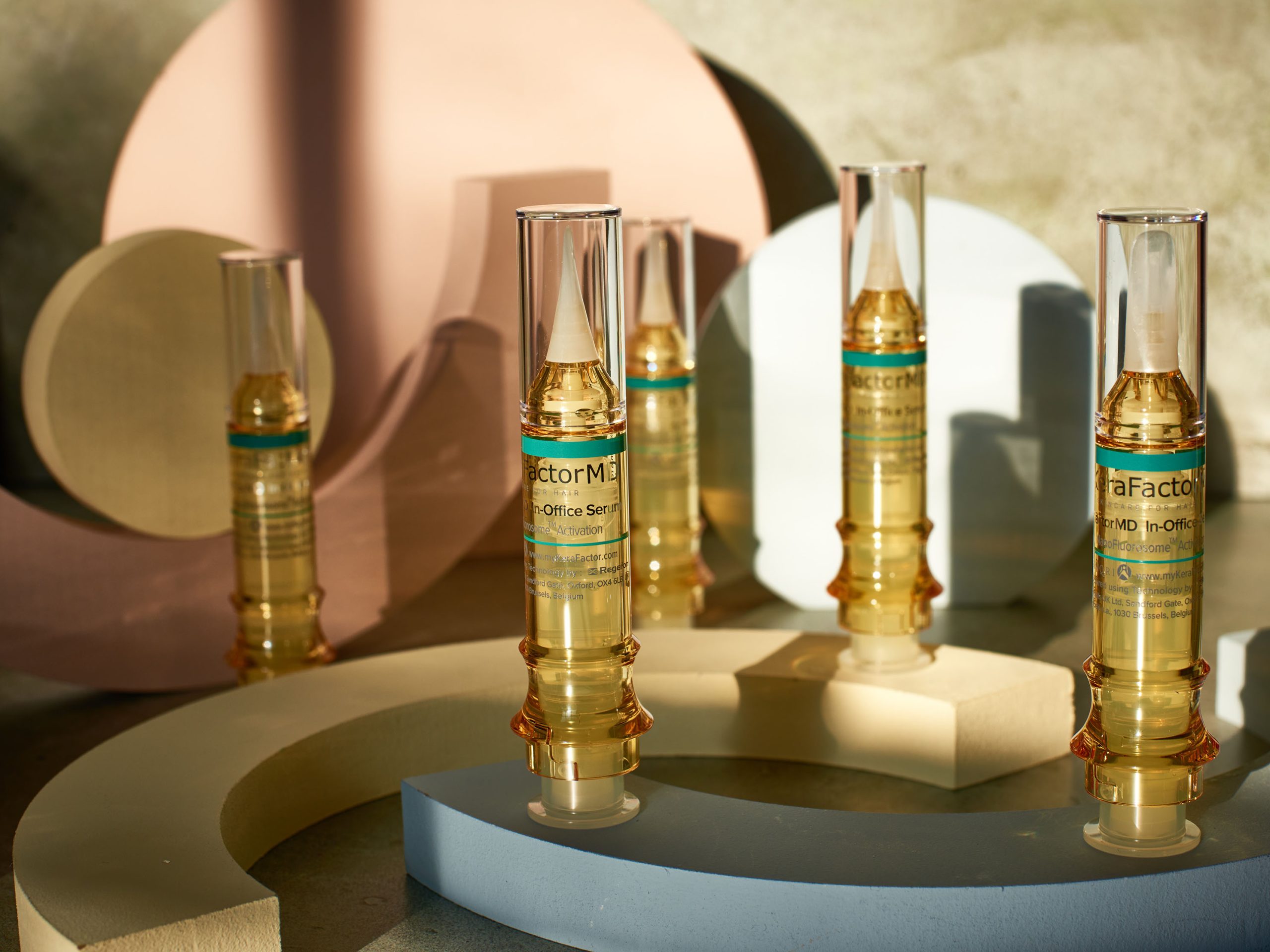
KeraLase is an in-office scalp treatment that uses the Lutronic Ultra laser to create tiny micro-channels in the scalp, then applies KeraFactor MD serum so it absorbs far deeper than it would on unbroken skin. There are no needles, no numbing and no downtime; clients describe the laser as warm and slightly tingly.
Here’s the mechanism in plain terms. The Ultra is a 1927 nm thulium laser that does non-ablative resurfacing, meaning it creates microscopic channels without removing the surface of the skin (the same laser we use for laser skin resurfacing on the face). Those channels are the delivery system: the manufacturer reports 5 to 7 times higher absorption of the serum’s nano-liposomes through them compared with intact scalp. The serum itself, KeraFactor MD, contains eight biosynthetic growth factors along with PDRN, which are the signals that nudge resting follicles back toward growth. We finish each session with red light therapy, because low-level light has its own evidence: a meta-analysis of seven randomized trials found LLLT improved hair density versus sham devices in pattern hair loss.
Each session takes about 45 to 60 minutes, and you can drive yourself home and go straight back to work.
Is KeraLase a good hair loss treatment for women?
Yes, and it’s the majority of who we treat. Female pattern thinning, hormonal shifts, postpartum shedding that never fully recovered, shedding on a GLP-1 weight-loss medication and stress-related shedding all respond well to a treatment that wakes resting follicles without medication or surgery.
Women’s hair loss gets treated differently for a reason. Many women don’t want to be on a daily prescription indefinitely, and the AAD notes that even minoxidil, the most recommended option, takes six to 12 months of continuous use before you know if it’s working. KeraLase isn’t a replacement for that conversation, but it gives us something that works on the scalp directly, with no downtime and no effect on color-treated or chemically processed hair. Men with early thinning get the same benefit; we just see more women, because that’s who we built this clinic for.
KeraLase vs PRP vs hair restoration in Scottsdale: which one is right for me?
If your hair is thinning but you still have coverage, KeraLase or PRP is the right conversation; if you have bald areas with no follicles left, hair restoration surgery is. Most people searching for hair restoration in Scottsdale are earlier in the process than they think, and a good consultation will tell you which bucket you’re in before you spend anything.
| KeraLase (what we do) | PRP injections | Hair transplant | |
|---|---|---|---|
| Best for | Early to moderate thinning, shedding, women’s hair loss | Early to moderate thinning | Bald or scarred areas with no live follicles |
| How it’s done | Laser micro-channels + growth-factor serum + red light | Your blood is drawn, spun, and injected into the scalp | Follicles surgically moved from the back of the head |
| Needles | None | Yes, many injections per session | Surgical |
| Downtime | None | Usually a day or two of soreness | Days to weeks |
| Sessions | Series of 6, four weeks apart | Typically a series, then maintenance | Usually one procedure |
| Starting price here | $650 per session | Not offered | Not offered |
We don’t do PRP or transplants, and we’ll tell you honestly if you’d be better served by someone who does. That’s the “no upsells” part of how we work.
Why doesn’t one treatment at a time work?
Because hair grows in overlapping cycles, and a single treatment only ever reaches the follicles that happen to be in the right phase when you do it. To get lasting, visible growth you have to treat across cycles and from more than one direction at once.
This is the part I want to say in my own words, because it’s what I’ve learned from clients rather than from a textbook. The two mistakes I see over and over are trying one treatment at a time, and stopping too early. Someone does two KeraLase sessions, or two months of a serum, sees a little less shedding, and stops, right before the follicles they woke up would have produced a visible hair. Then they conclude it “didn’t work.”
What actually works, in my experience, is finding the root cause for that specific person and then combining the in-office treatment with the things they can do at home: medication when a provider recommends it, an at-home LED cap, five minutes a day of scalp massage, and a growth shampoo and serum used consistently. Hair has multiple cycles, and you get the best result when you treat each cycle rather than hoping one push carries through. That’s why our plan is a series, and why we send you home with a routine rather than just a follow-up date.
How many sessions will I need, and when will I see results?
Most clients do a series of six treatments spaced four weeks apart. Reduced shedding usually shows first; visible new growth typically begins around three to six months because hair grows in slow cycles. See a hair growth before and after from a KeraLase series.
That timeline isn’t us being cautious. It’s biology. A follicle you wake in month one still has to push a new hair through the scalp and grow it long enough to see, which is why almost every hair-loss treatment, including prescription options, is judged at the six-to-12-month mark. After the initial series, maintenance depends on your hair loss: some people only need their at-home care products, some come back a year later and some after six months. It depends on each person.
How much does KeraLase cost in Scottsdale?
KeraLase at Skin With Bea is currently $650 per session, less per session when you buy a series, and every plan begins with a consultation (free; new clients place a $50 deposit that is credited toward your treatment, or refunded on request). We price the series and the at-home routine together so you know the full picture before you start.
We’ll also tell you at that consultation if we don’t think KeraLase is the right spend for you. A treatment that won’t hold isn’t a deal at any price.
Is KeraLase FDA-approved?
No hair-loss treatment called KeraLase is FDA-approved. The Ultra laser it uses is an FDA-cleared device indicated for dermatological procedures, and KeraFactor MD is a topical serum; the KeraLase protocol is the pairing of the two.
We say this precisely because a lot of clinics don’t. “FDA-approved” and “FDA-cleared” mean different things, and neither one is a promise about hair. What you should ask any provider is who is doing the treatment and what their plan is if it isn’t working.
More questions I get about hair loss treatment
No needles and no numbing; clients describe the laser as warm and slightly tingly. Each session takes about 45 to 60 minutes, you drive yourself home and go straight back to work.
No, and we would rather you hear that from us. The manufacturer is clear that it stimulates follicles that are resting or dormant; it does not create new ones. That is why the earlier you treat thinning, the more there is to work with, and why bald, scarred areas are a hair-transplant conversation.
Yes. The treatment works on the scalp, not the hair shaft, so it has no effect on color-treated or chemically processed hair.
Treat the in-office session as one part of the plan: medication when a provider recommends it, an at-home LED cap, five minutes a day of scalp massage, and a growth shampoo and serum used consistently. Stopping after two sessions, right before woken follicles produce a visible hair, is the most common reason people think it did not work.
Usually not. Shedding often starts about two months after giving birth, peaks around four months and settles on its own. If it has not settled, or you had thinning before pregnancy, that is when a consultation is worth it. Read my full guide to postpartum hair loss treatment in Scottsdale.
About the author
We’re at 7054 E Cochise Road B100, Scottsdale, AZ 85253, on the Paradise Valley side of Scottsdale, and we see clients from Phoenix, Arcadia, Tempe, Cave Creek, Fountain Hills and North Scottsdale. Hours are Monday to Friday 10am to 6pm and weekends 11am to 5pm, by appointment.
Every treatment here is performed by Beatrice Moorefield, RN, LE, LSO, or by a certified aesthetic registered nurse who is also a Certified Laser Technician, trained on her protocols and supervised by founder Beatrice Moorefield, RN, LE, LSO, with medical oversight from our Medical Director, Abbey Jensen, MSN, FNP-C. No upsells. No trendy gimmicks. Just honest, science-backed care, and a plan built around your scalp rather than a package.
Schedule your consultation or call (480) 405-0100. New clients hold their spot with a $50 deposit; after the visit it goes toward your treatment or is refunded on request.
Written by Beatrice Moorefield, RN, LE, LSO — aesthetic registered nurse, licensed aesthetician, skin health educator, and founder of Skin With Bea Esthetics, Scottsdale.
Disclaimer:
The information provided on this website is for general informational purposes only and is not intended as a substitute for professional medical advice, diagnosis, or treatment. Always seek the advice of a qualified healthcare provider with any questions regarding a medical condition or treatment. The content on this website is not intended to diagnose, treat, cure, or prevent any disease. Use of this information is at your own risk. We are not responsible for any adverse effects or consequences resulting from the use of any information provided.